I especially like the escape-room style approach (solve, earn points, keep moving), and I like that you can start when you want and go at your own pace without waiting for a group. The main drawback is simple: you’re walking a route with stairs and you’ll need to read the clues in English on your smartphone, plus bring a pen.
If you’re the type who enjoys figuring things out on foot, this is a fun way to see Edinburgh’s New Town beyond the usual photo stops.
Key things that make this Quest worth your time

- Calton Hill to St Andrews Square in one flow, with the views early and the finishing square as a payoff
- An app-led, no-guide format that keeps the experience private and flexible
- Puzzles plus a leaderboard option, so you can race or wander and still feel engaged
- A practical outdoor route that clocks about 2.2 miles with lots of chances to pause for coffee
- Small-group pricing (up to 5 people) that can be a good value if you’re traveling together
Calton Hill Start: your first clues with city-wide views

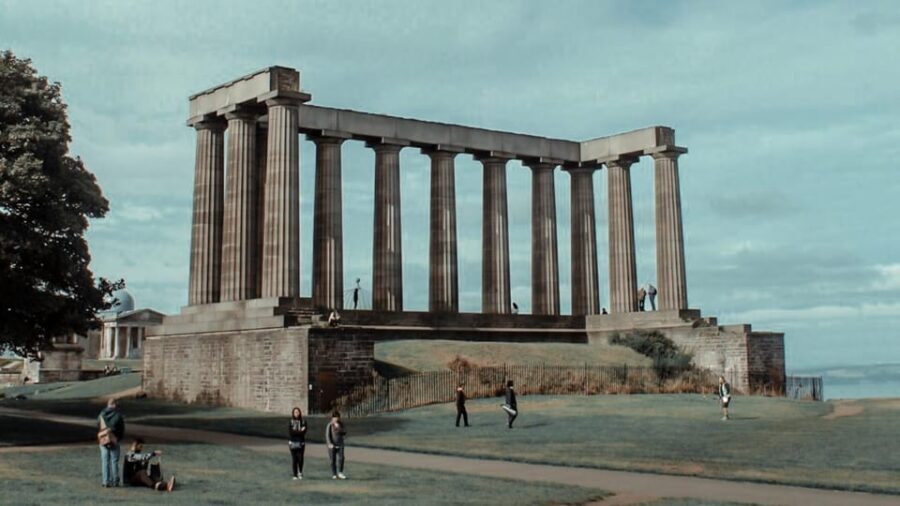
The Quest begins at Calton Hill, and that’s a smart choice. You get big sightlines right at the start, so your brain locks onto the geography of Edinburgh early. It also sets a mood: you’re not just “walking to points,” you’re orienting yourself.
Once you start the app, your first steps are about getting the route into your head. Expect the clues to pull you through the New Town streets, pushing you to look closely instead of just strolling past.
If you’re arriving during busy times, don’t stress about exact coordination. This is self-guided, so you can start when your group is ready and take breaks whenever you need them.
How the Go Quest App Works (and why it feels different than a normal tour)

This isn’t a classic guided walking tour. It’s an interactive adventure delivered through the Go Quest Adventures app, and there’s no guide on site. You’ll redeem a code that’s emailed to you, then follow the on-screen instructions to run the experience.
Here’s the practical appeal: you can decide your rhythm. If you like a brisk pace, go for the leaderboard. If you want slow travel, you can stop often for photo breaks and snacks without anyone herding you along.
One thing to be ready for: the app is English only. If your group can’t comfortably read English, you’ll likely feel stuck when the puzzles rely on text.
Walking the New Town Route: Georgian streets to Princes Street Gardens
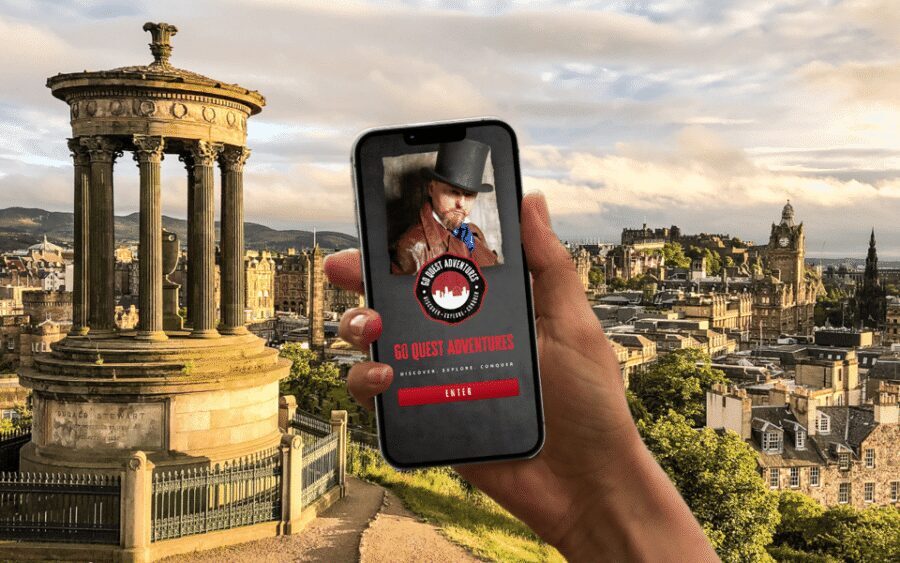
The path the Quest takes is designed to show off the “Athens of the North” side of Edinburgh. After Calton Hill, you wind down through Georgian streets and into the landscaped calm of Princes Street Gardens.
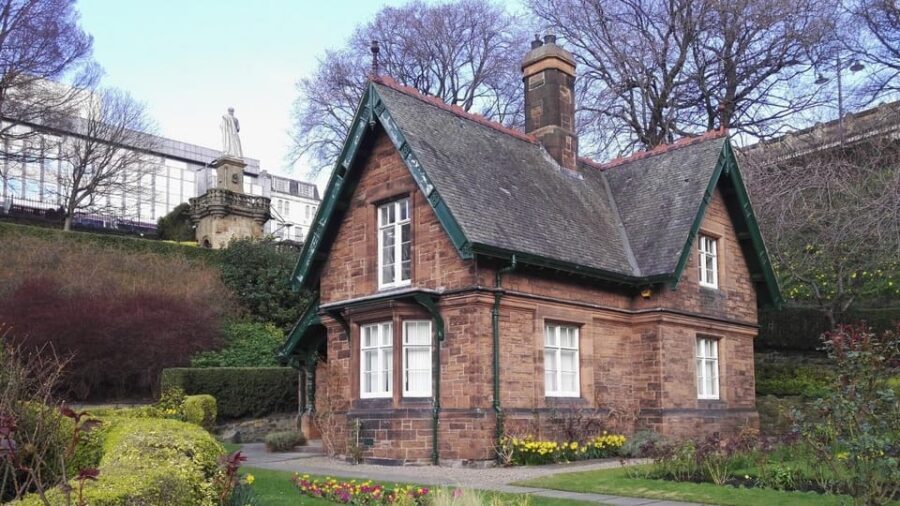
Princes Street Gardens is a nice mid-route change of pace. Instead of constant foot traffic and shop-front distractions, you get a break where you can actually slow down and regroup. It also helps you reset if you’ve chosen a faster pace earlier.
Then the route ends at St Andrews Square, a recognizable finish that gives you a clean “we did it” landing point. That matters for a puzzle walk, because it keeps the whole experience from feeling like an endless scavenger hunt with no closure.
Puzzles, points, and the escape-room vibe you control
The Quest is built around challenges you solve as you travel. Think of it as an outdoor escape-room twist: you’re moving through real streets and then using clues and puzzle logic to keep the story moving.
You also get a choice in how you experience it:
- Treat it like a casual walk and enjoy the clues at your own tempo
- Or push for a race feel and compete for top placement on the leaderboard
What I like about this setup is that it fits different group personalities. One person can go full puzzle mode while someone else focuses on the streetscape and views. Nobody has to “keep up” with a guide.
Just don’t underestimate how much the puzzles change your attention. This isn’t only about where you walk. It’s about how you look—signs, street patterns, and small details become part of the game.
Timing on your feet: 2.2 miles, stairs, and where breaks make sense

The Quest length is about 2.2 miles, and average completion time runs roughly 2.5 to 3.5+ hours depending on your group and how often you pause. There are plenty of places to stop for coffee and rest, which is key on a route like this.
Now the caution: there are stairs, and the experience notes it’s not suitable for wheelchair users or prams due to the amount of stairs. Even if something is marked as wheelchair accessible in one place, the route description you’re given points to a tough reality on the ground—plan for steps.
Also, the Quest is suggested for daylight hours. In the dark, it becomes harder to find clues and solve puzzles at the pace the game expects. If you’re trying to squeeze it into evening, bring a plan for slower solving and extra lighting on your phone.
Price and value: $37 for up to 5 people (this can be a bargain)
At $37 per group up to 5, the math gets interesting fast. A per-person price can quickly become painful in cities like Edinburgh, especially when you’re walking anyway. Here, you pay for the group experience through the app, not an individual guide-driven hour.
Value depends on your group size:
- If you’re traveling as a couple, you still get a full activity that can easily fill a half-day window
- If you have three to five people, the per-person cost drops meaningfully
- If you’re solo, it’s still a good option if you enjoy puzzles, but you lose that group discount effect
Entry to attractions is not included, so think of this as a “walk-and-solve” experience. You can visit places along the way if you want, but the Quest itself is the main event.
If you already plan to do a lot of Edinburgh walking, this is a good way to make that time feel structured and playful rather than just moving from stop to stop.
What to bring so the game actually runs smoothly
This experience is simple, but it depends on a few essentials. You’ll need:
- A charged smartphone with the app downloaded
- The email code to redeem in the app
- A pen and paper (listed as a must for solving puzzles)
- Comfortable shoes and weather-appropriate clothing
The pen/paper detail matters more than it sounds. Puzzle games sometimes involve notes you’ll want to reference while moving through streets, and carrying a small notebook saves frustration.
Also, because the Quest is phone-based, make sure your device battery won’t die halfway through. Edinburgh weather can change quickly, and you’ll likely use your screen more often than you think while solving.
Who this is best for in Edinburgh (and who should skip it)
This Quest works well for:
- Couples who want a guided-feeling experience without joining a group
- Families looking for an active, screen-based game format on foot
- Groups of friends who like friendly competition and puzzles
It’s also a strong fit for team-building in the casual sense, since you’re coordinating as you solve challenges.
However, keep these limits in mind. It’s listed as not suitable for children under 8. At the same time, it also says children under 8 go free / are included for free. That mismatch suggests you should treat the age guidance carefully and consider whether the puzzles and walking route are realistic for younger kids.
If your group can read English comfortably and you’re fine with stairs, you’ll probably enjoy the flow. If not, choose a different Edinburgh walking option.
Weather, pacing, and the best time to play

The route works best in conditions where you can see clearly and feel comfortable stopping. The suggestion is daylight hours because clue-finding and puzzle-solving are harder at night.
If the weather is wet, you’ll still be able to play, but go slower. On puzzle walks, speed usually hurts more than helps. Extra time also means more chances to use cafés and rest stops, which the route naturally supports.
For pacing, decide your group strategy at the start:
- Are you here to win the leaderboard, or to enjoy the day?
- How often do you want to stop for photos and breaks?
If you plan that before you begin, the Quest feels fun rather than stressful.
Should you book this Edinburgh New Town Quest?
Book it if you want an outdoor walking activity that feels like an escape room, with a flexible schedule and a private group experience. The combination of Calton Hill views, Georgian streets, and an end at St Andrews Square gives the route a satisfying arc, and the puzzle structure helps you see more than just the obvious sights.
Skip or reconsider if your group can’t handle stair-heavy walking, needs an option with accessibility accommodations, or prefers a guided narrative instead of app-based puzzles. Also think twice if your group can’t read English, since the app is English only.
For the right crew, this is a smart way to turn a half-day in Edinburgh into something you’ll actually remember.
FAQ
Where does the Edinburgh New Town Quest start?
It starts at Calton Hill. After you download the Go Quest Adventures app and redeem the emailed code, you’ll follow the instructions in the app to begin.
How long is the Quest, and how long will it take?
The route is about 2.2 miles. Completion time averages about 2.5 to 3.5 hours, but it can take longer depending on your group and how many breaks you make.
What’s included in the price?
You get a self-guided city adventure through the Go Quest Adventures app in English only, plus puzzles and challenges as you explore. Entry into attractions is not included.
Do I need a guide?
No. There’s no guide on site. You play through the app on your own.
Do I need to bring anything?
Yes. You need your own smartphone, and it should be charged. You also should bring a pen and paper, plus comfortable shoes and weather-appropriate clothing.
Can I start at any time?
You can start whenever you want, with instant access after redeeming your code in the app. The activity is suggested for daylight hours because solving clues is harder in the dark.
What does the $37 price cover?
One ticket covers up to 5 people within the app for one low price. Children under 8 are listed as included for free.
Is it available in languages other than English?
No. The app is available in English only.
Is it wheelchair accessible?
The information includes accessibility notes, but it also states the Quest is not suitable for wheelchair users or prams due to stairs. If accessibility is a key concern, you should plan carefully.
What’s the cancellation and booking flexibility?
You can cancel up to 24 hours in advance for a full refund. It also lists reserve now & pay later, and the experience is valid for 365 days.
]]>What really sold me is the freedom: you can pause for shops, take photos, or simply linger without working around a group. The other big win is the offline VoiceMap access, so you’re not stuck hunting for signal. One caution: this is not a guided museum crawl, so if you want to step inside places mentioned along the way, you’ll need to pay separately.
Key tour highlights you’ll feel on the walk

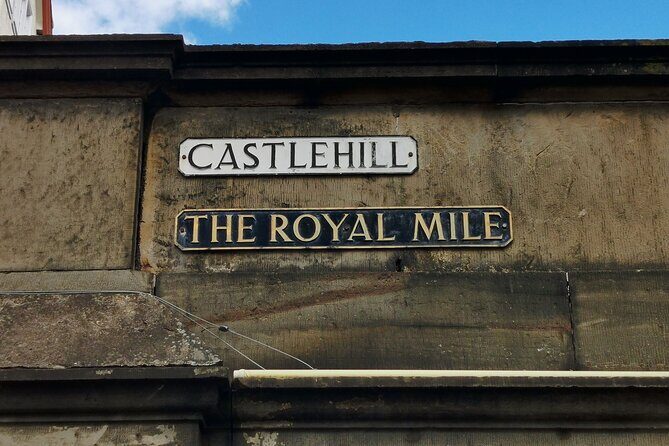
- Self-paced timing along the Royal Mile’s four sections: Castlehill, Lawnmarket, High Street, and Canongate
- Edinburgh Castle’s early witch burnings, set at the start near the Witches Well
- Deacon Brodie—the so-called gentleman robber tied to Dr Jekyll and Mr Hyde inspiration
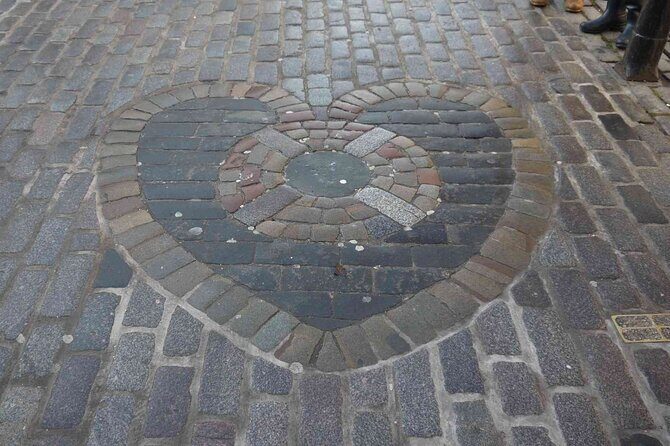
- St Giles Cathedral area stops, including the Old Tolbooth and the Heart of Midlothian mosaic
- Mercat Cross and 1600s punishment stories, plus the Paisley Close rubble rescue
- Ends at Holyroodhouse, giving you a clean finish point at the Palace of Holyroodhouse
What you’re really paying for: a Royal Mile story you control

For $19.99 per person, you’re not buying a ticket to a single attraction. You’re buying a guided walk you can repeat with lifetime access in English. The real value is that you get a tight route through Edinburgh’s Old Town without needing to join a group, wait for anyone, or squeeze your day into someone else’s pace.
The tour runs about 45 minutes to 1 hour 15 minutes depending on how often you stop. That range matters. If you want a quick orientation to Old Town, you’ll appreciate how much ground gets covered. If you prefer slow strolling, you still have enough structure to keep the walk from feeling random.
You’ll use the VoiceMap app on your Android or iOS phone. The key convenience is that you get offline access to audio, maps, and geodata. So even if mobile reception gets shaky around busy streets, your tour doesn’t suddenly turn into guesswork.
One more practical point: you’ll need your own smartphone and headphones. The tour does not include them, and there’s no substitute once you’re standing at the start line.
Starting at the Witches Well: Castlehill’s cold open
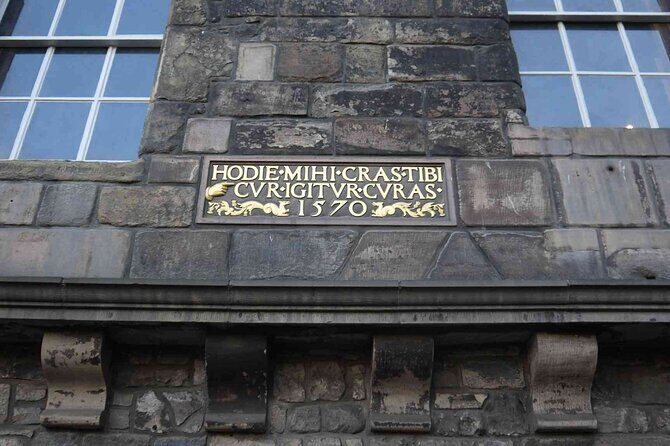
The walking tour begins at the Witches Well on Castlehill (EH1 2ND). It’s a strong opener because the first stories aren’t just legends for fun—they’re the kind of grim early-Edinburgh accounts that make the city feel real.
From the start, you’ll hear about Edinburgh Castle’s early days and the infamous witch burnings tied to this area. If you only know Edinburgh for ghost tours and “spooky vibes,” this is where you’ll get the darker context. It also gives you an immediate sense of place: you’re not just strolling past landmarks; you’re walking through the city’s historical fear and conflict.
Timing-wise, getting your headphones going right away helps. You’ll be tempted to stop and look at your surroundings, but since the opening is tied directly to the location near the Castlehill top, it’s best to start the audio as soon as you’re there so the stories land when you can actually see the setting.
Walking the Royal Mile: 1¼ miles, four distinct neighborhoods

The route doesn’t treat the Royal Mile as one generic street. It breaks it into the four sections you’ll walk in sequence: Castlehill, Lawnmarket, the High Street, and Canongate. That matters because Edinburgh’s Old Town changes feel as you move.
You’ll hear stories across the whole span, not only at a couple of “postcard” stops. In practice, that makes the Royal Mile less like a conveyor belt of tourists and more like a timeline you can feel under your feet.
Here’s the balancing act: the Royal Mile is also a shopping district, and it can be crowded. That’s where self-guided shines. You can slow down when the audio is describing something you want to picture, and speed up when you just want to get to the next stop without wrestling through a group.
Deacon Brodie: the gentleman robber side of Edinburgh
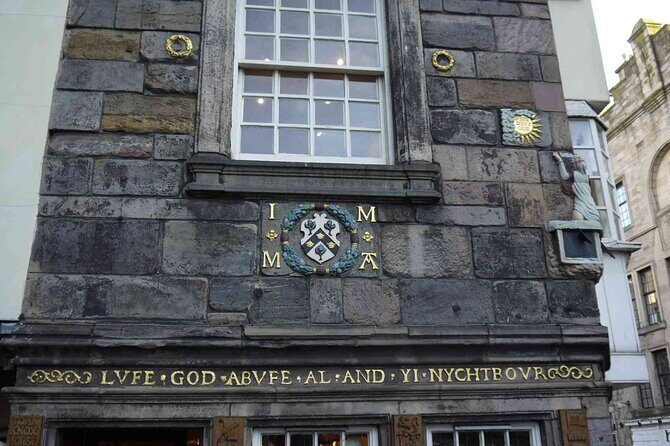
One of the most fun (and oddly human) themes on this walk is crime—especially the legend of Deacon Brodie. The audio points you to his former residence, and the story ties him to Robert Louis Stevenson’s Dr Jekyll and Mr Hyde.
This is the kind of stop that works because you’re not learning in a classroom. You’re looking at an address and hearing why it’s associated with the double-life concept. It turns “a street building” into something you can picture in a narrative.
If you enjoy character-driven history—stories about people rather than dates—you’ll probably feel this part click. It’s also a nice break from the heavier church-and-punishment material coming up later.
Old Tolbooth Wynd: history on a side path

As you move along, the tour takes you past Old Tolbooth Wynd, and the audio explains what that space meant historically while you walk by.
This is a useful reminder: Old Town isn’t only big, obvious sights. It’s also those narrow lanes where life happened—transactions, disputes, and the kind of everyday encounters that didn’t always make it into the most famous postcard views.
I like this type of stop because it trains your eyes. Once you hear the name of a place and why it mattered, you start noticing how the city was built for movement, separation, and access between main areas and side streets.
St Giles Cathedral area: Old Tolbooth, Heart of Midlothian, and Charles II

A major mid-walk highlight is St Giles Cathedral, where the audio references several well-known features in the surrounding area: the Old Tolbooth, the Heart of Midlothian mosaic, and a statue of Charles II.
Even if you don’t plan to go inside anything, this is the kind of area where the story audio gives you instant direction on what to look for. St Giles is also a good “pause point” because it’s a natural place to slow down and take in details while the audio frames what you’re seeing.
A practical note for your timing: if you want to stop for photos or read plaques, this is a good place to do it. The audio is still useful even if you only skim the visuals, but letting yourself linger makes the stop feel like more than a waypoint.
Mercat Cross shadow stories: mob violence and 1600s punishments
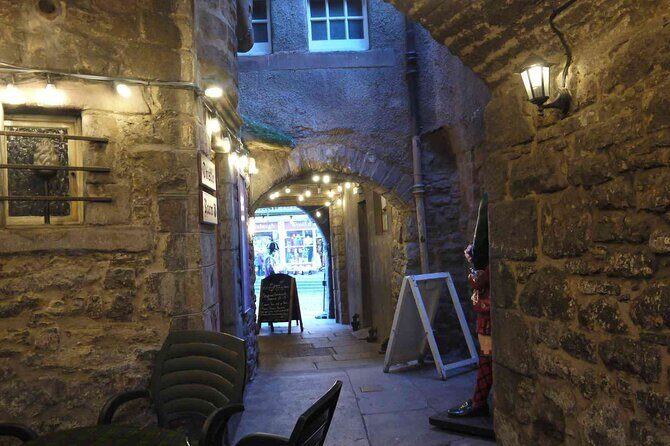
Not all of the Royal Mile stories are polite or distant. The audio brings in grim accounts connected to the Mercat Cross area—things like the priest pelted to death by an angry mob, plus other terrible deeds said to have happened in its shadow.
This isn’t just shock value. It helps you understand a key theme of old cities: public spaces were where power was performed—sometimes cruelly, sometimes brutally. When you hear the story while you’re walking through the exact kind of central civic space described, it stops feeling like abstract history.
Later, you’ll also hear about barbaric punishments meted out to criminals in the 1600s. Again, you’re not watching a show. You’re learning how the city used public space for enforcement, warning, and spectacle.
If you prefer lighter tours, this portion may feel intense. But if you want a sense of Edinburgh beyond its image, this is where the Old Town’s edge shows up.
Tron Kirk and the Paisley Close disaster rescue story
The tour also routes you past the Tron Kirk, with history tied to that stop. This section includes both serious and human moments, including stories about punishment and a more heartbreaking-but-heartwarming detail: a young lad pulled from the rubble of the Paisley Close disaster.
That combination is one reason the audio walk works. It doesn’t stay locked in one emotion. You get the city’s harshness, then you get a story of survival that reminds you people lived through real catastrophes here—not just kings and philosophers.
If you like your history with a human thread, you’ll probably remember this moment longer than you expect.
John Knox and Mary Queen of Scots: religion and royal tragedy
As you keep heading toward Canongate, the tour shifts toward major figures of Scottish history. You’ll hear about John Knox, described in the tour as a leading figure in the Scottish Protestant Reformation, along with royal tragedies like the execution of Mary Queen of Scots.
This is a helpful part of the walk because it gives you the wider “why” behind the earlier church-related tension. Witch trials, mob violence, and public punishment all sit in the same broad historical landscape—conflict over power, beliefs, and legitimacy.
Even if you already know Mary Queen of Scots at a headline level, hearing her story placed into the walking route helps it feel less like a random biography and more like something that shaped how Edinburgh functioned.
Netherbow Port and Canongate Kirk: leaving the Old Town core
Near the later stretch, you’ll pass Netherbow Port, once described as the main gate between Edinburgh and Canongate. That detail matters because gates weren’t decoration—they were control points. They helped define movement and separation.
From there, you’ll also hear the history while you pass Canongate Kirk. This section moves you out of the densest “center” feeling and toward the finishing zone, so the story naturally tapers toward an ending.
Ending at Holyroodhouse: a clean finish point
The tour ends at the Palace of Holyroodhouse in front, at the end of Canongate (EH8 8DX).
This final point is practical. It gives you a clear “done” location instead of a loose loop. You can build the rest of your day around it—grab food nearby, hop onto public transport, or keep exploring without wondering how far you still need to walk.
And emotionally, the ending makes sense. You start near castle power and ends near royal power, with all the middle chapters—crime, religion, public punishment—filling in what people lived through between those poles.
Timing and pacing: how to keep it fun, not rushed
The tour is built for a walk you can shape to your day. One of the biggest strengths is letting you set the pace. If you want to stop to shop, watch street life, or pause for views, you can. If the street feels too crowded, you can move faster and let the audio catch up.
My practical suggestion: plan for a simple buffer. If you start at 12:00 noon or later (the provided hours run 12:00 AM to 11:59 PM), give yourself enough time so the audio doesn’t feel like a race. Even though the tour can be done in under an hour, your real time cost is stopping for photos and reading small signage.
Also, download and test your audio before you hit the busiest blocks. You’ll thank yourself when you’re standing at the start near Witches Well trying to get sound working.
Price and value: $19.99 for lifetime access plus offline audio
Let’s talk value, because this is where smart travelers win.
At $19.99, you get:
- Lifetime access to the tour in English
- VoiceMap access on Android and iOS
- Offline access to audio, maps, and geodata
So if you come back to Edinburgh later in the year—or you know someone else who visits—you’re not paying again for the same route. That’s a strong reason this isn’t just a one-time “tour tax.”
It also saves time compared with waiting for a live guide. And if you don’t want a long sit-down museum experience, you still get the context you’d normally pay for in a guided format.
The only real value trade-off is that you’re not getting a live person answering questions. You’re getting a story-driven route. If you want interaction, this won’t replace that. If you want freedom and focus, it’s a great fit.
Should you book? Here’s who this audio walk suits best
Book this if you:
- Want a self-paced Royal Mile walk that you can do in about an hour
- Like history told through places, not just facts on a page
- Prefer avoiding group logistics in a crowded, shopping-heavy corridor
- Want offline audio so your day runs smoothly even on patchy reception days
Skip it (or pair it with something else) if you:
- Expect a guided service inside museums and attractions
- Don’t want to use a phone and headphones during your walk
- Want a deep, official guide-style explanation beyond what fits in audio segments
FAQ
FAQ
How long is the Royal Mile self-guided audio tour?
It takes about 1 hour to 1 hour 15 minutes for most people, with many guides saying it works out to around a 45-minute stroll depending on stops.
Where does the tour start and end?
It starts at the Witches Well, Edinburgh EH1 2ND and ends in front of the Palace of Holyroodhouse at Canongate, Edinburgh EH8 8DX.
Is there a live guide with you during the walk?
No. It’s a self-guided audio tour using the VoiceMap app. Only your group participates.
What language is the tour available in?
The tour is offered in English.
Do I need headphones and a smartphone?
Yes. The experience includes the VoiceMap app and offline audio, but it does not include your smartphone or headphones.
Can I use the audio without cell service?
Yes. You get offline access to audio, maps, and geodata.
Are museum visits included when the tour mentions attractions?
No. The tour does not guide you through museums or other attractions mentioned along the route. If you want to enter, you’ll pay separately.
Is the tour always available during the day?
The listed opening hours show it as operating Monday through Sunday, 12:00 AM to 11:59 PM, during the stated date range.
Final call
If you want a smart, flexible way to learn the Royal Mile without getting trapped in group timing, this audio walk is a good buy. You’ll get a strong arc—from witch burnings near Castlehill to Holyroodhouse at the end—plus enough variety (crime, religion, public punishment, royal tragedy) to keep the walk from feeling like one long history lecture.
]]>Two things I really like: the storytelling stays sharp and not overly dry, and the directions feel practical enough that you won’t spend your time hunting for the next point. The narration is also high quality—one narration named Kat is called out for being interesting without turning textbook-cold.
The main drawback is the usual self-guided trade-off: you need your own smartphone and headphones to make it work, and the route climbs up toward the castle area.
Key Highlights You’ll Actually Feel While Walking
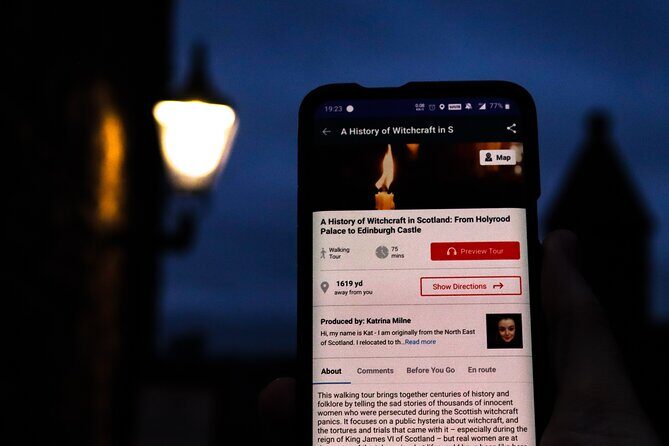
- Royal Mile route with a clear start and finish: begin near Palace of Holyrood and end up at the top of Castlehill by the Esplanade
- Offline-ready audio and maps so you’re not stuck if your signal gets spotty
- Professional, engaging narration (not just facts dumped in order), including a named narration by Kat
- Stop-by-stop structure that keeps the walk moving: Parliament, Bake House Close, John Knox House, St Giles’ Cathedral area, and more
- Real-World context for the darker parts of the witchcraft story, including mention of torture methods used to extract confessions
Why This Witchcraft Audio Walk Works on the Royal Mile
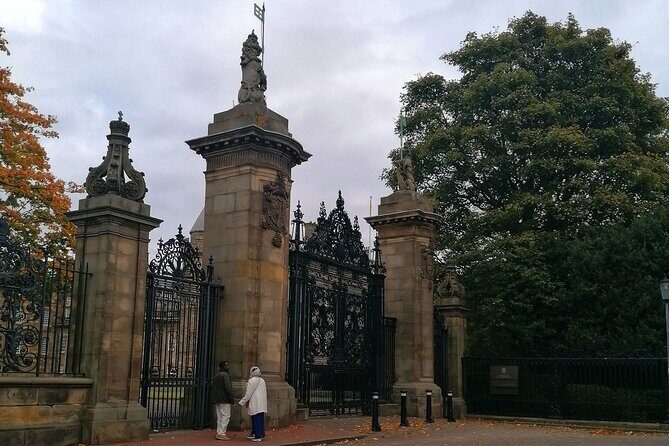
This tour is built for how Edinburgh feels on foot. You’re not “doing” one museum room at a time—you’re moving through a real historic spine, so the stories land where the streets actually are. From Holyrood House up toward Castlehill, the route naturally guides your pace and attention.
The best part is that it uses walkable waypoints. You get enough structure to stay oriented, but the tour never turns into a rigid checklist. That matters because Edinburgh can move fast: crowds, traffic noise, and the temptation to rush. The audio keeps you engaged while you’re still free to pause for photos.
If you like history that has a human edge—beliefs, laws, fear, and consequences—this tour fits well. It also doesn’t pretend every chapter is pleasant; you’ll hear about the harsh realities of witchcraft accusations, including torture methods described as part of the confession process.
Price and What You Really Get for $9.99
At $9.99 per person, this is a low-cost way to add a thematic layer to your Edinburgh walk. You’re paying for three things: the VoiceMap narration, the route guidance, and the ability to use it later thanks to lifetime access.
That lifetime access is a bigger value than it sounds. If you visit Edinburgh again (or you want a second pass on a different day), you’re not paying twice. And because the app includes offline access to audio, maps, and geodata, you can use it even when coverage isn’t ideal.
One more value point: it’s English-only and designed to work on your schedule. You’re not buying a ticket for a dated time slot that can be ruined by weather or slower walking pace. You simply start and follow along.
Getting Started Outside Palace of Holyrood: Set Up Fast

Your tour begins at Edinburgh EH8 8DU, outside the Palace of Holyrood. This matters because it places you right where the story connects to Edinburgh’s ceremonial power and political geography—Holyrood is a strong “beginning” without needing a complicated transfer.
Before you start walking, make sure you’re ready to go:
- Bring your phone fully charged.
- Have your headphones handy (they’re not included).
- Use the VoiceMap app for Android or iOS and take advantage of offline access for the audio and maps.
Once you’re at the starting point, the tour begins with a quick setup moment: how to use the app and what to expect. That’s a small thing, but it keeps you from wasting early minutes while you’re already in motion on the Royal Mile.
The Walking Route: Holyrood to Castlehill, Stop by Stop
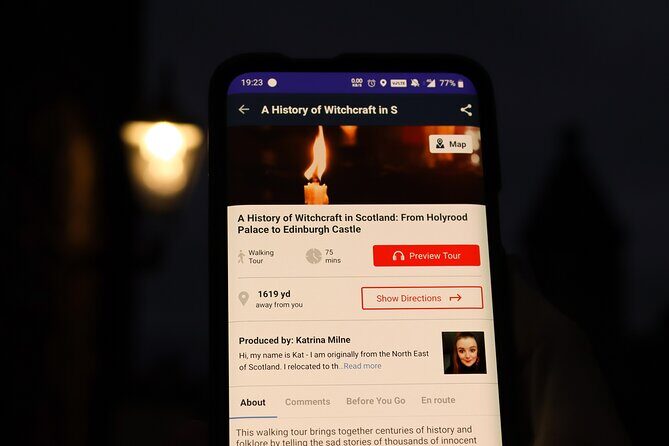
This is a 1 to 1.5 hour self-guided walk, roughly following the Royal Mile up toward Castle Hill. The flow is simple: you’ll move from waypoint to waypoint, hearing each piece of the witchcraft story at the location where it connects.
Holyrood to the Royal Mile Lead-In
Right away, the audio orients you to the route and what’s coming next. After that, you’ll follow a section of the Royal Mile from Holyrood House up toward the top of Castle Hill.
That Royal Mile stretch is doing more than serving as a path. It becomes your timeline. As you walk, the narration helps you connect witchcraft beliefs to laws, religious pressure, and how power was experienced on the streets.
Passing the Scottish Parliament
You’ll pass by the Scottish Parliament and get a bit of context as you walk. Even though this stop isn’t the core of witchcraft trials, it’s useful because it reminds you: laws and authority don’t show up only in the past. You’re moving through a modern seat of governance while hearing about older rule-making and enforcement.
Practical tip: keep walking rather than stopping for long here. The audio works best when you’re in motion and the next directions are coming up soon.
Bake House Close: Where the Story Gets Street-Specific
Next you’ll head into Bake House Close. Close spaces in Edinburgh can feel like little time capsules—narrow, tucked-away, and built for walking slowly and noticing details. Here, the tour uses that setting to talk about the history of witches before you continue.
This stop is especially good if you like stories tied to place rather than a lecture. A close feels more personal than a wide open square, and that helps the narration land with more texture.
John Knox House and the Scottish Witchcraft Act
From Bake House Close, you pass by John Knox House. This is one of the most pointed stops on the route because you’ll hear about John Knox and how he supported the Scottish Witchcraft Act.
Why this matters: it ties witchcraft fear to organized belief and legal consequences, not just rumors. You’re hearing how theology and policy could connect, which is usually where the most disturbing parts of this period begin.
If you want to understand the “why” behind accusations, this is a strong stop.
High Street: More Witchcraft Context While You Walk
As the route continues along High Street, the narration adds more background on witchcraft in Scotland. This is less about one single landmark moment and more about building momentum—like chapters of a story that keep tightening as you move upward.
I like this part because it doesn’t demand you memorize facts. It keeps the theme flowing while you’re still getting the feel of central Edinburgh.
St Giles’ Cathedral Area: Confession, Torture, and Consequences
You’ll go around the outside of St Giles’ Cathedral, and here the audio turns darker. You’ll learn more about witches and witchcraft, including torture methods used to extract confessions from suspected witches.
That’s not light content. If you’re sensitive to references like this, it’s smart to treat the area like what it is: a place where history includes cruelty. Even if you don’t stay glued to every grim detail, the narration provides context you can’t really get from a quick walk-by.
This stop is also valuable because it places you near a major church setting while you hear how religious structures and social pressure shaped outcomes.
Over Victoria Terrace: Major Thomas Weir, the Wizard of West Bow
Next you pass over Victoria Terrace and hear the story of Major Thomas Weir, also known as the Wizard of West Bow.
This is a good change of tone from the legal and torture-heavy parts. You still get to connect witchcraft narratives to named individuals and local legend, which helps you remember the tour and not just the overall theme.
Ending at Castlehill: The Last Witch of Scotland
The tour ends at the top of Castlehill, just before the Esplanade. As you walk up the street, you’ll hear the story of the last witch of Scotland.
Ending at the high point makes sense. Castlehill already gives you a physical sense of altitude and “from here you can see the city.” Psychologically, it also provides a natural finishing line to a walk about belief, punishment, and what people feared enough to accuse.
What “Self-Guided” Really Means Here (In a Good Way)

This is a private tour/activity in the sense that only your group participates, but it stays self-paced. That’s useful if you don’t want to keep step with a stranger while you’re processing heavy history.
You’re also choosing your level of attention:
- If you want to listen nonstop, you can.
- If you prefer pausing for photos, you can do that too.
- If you miss a section, you can replay audio in the app (the key is that you have offline access to the tour content).
Just keep one thing in mind: headphones are essential. Without them, you’d be missing the main experience.
How Long It Takes and How to Time Your Walk
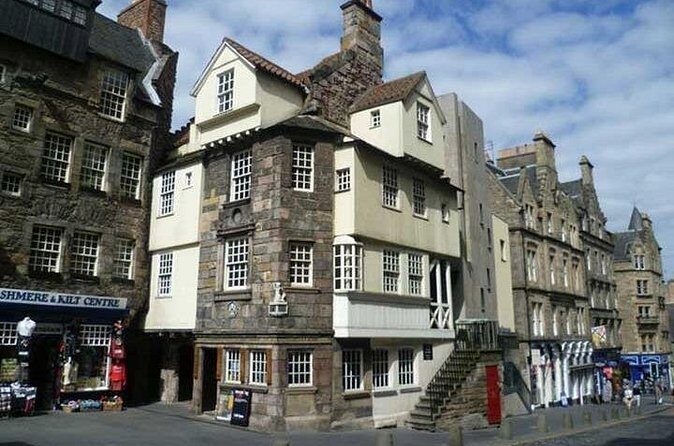
The duration is listed as about 1 hour to 1 hour 30 minutes. That range is realistic for this kind of route: it’s walkable, but you’re stopping for narration at multiple points, including narrow close spaces and an uphill finish.
My advice: plan to start when you can comfortably walk the full Royal Mile length and reach Castlehill without rushing. If you’re visiting other sights that day, leave this one enough buffer time. This isn’t a “sprint” kind of tour.
Who This Tour Is Best For
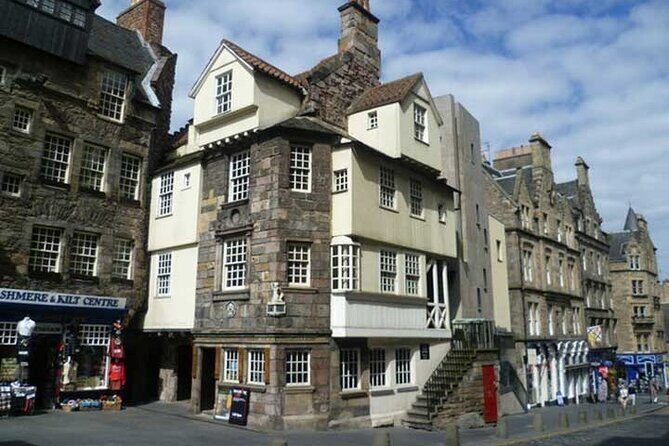
This works especially well if you:
- Want a value-priced audio way to learn about a specific theme in Edinburgh
- Enjoy walking routes with clear direction and built-in narration
- Are curious about how belief, law, and fear intersected in Scotland
It may not be the best fit if you:
- Dislike hearing about torture methods and confession extraction connected to witchcraft accusations
- Prefer a fully guided experience where someone handles timing and navigation for you
Should You Book the A History of Witchcraft in Edinburgh Audio Tour?

If you’re looking for a low-cost way to turn a Royal Mile walk into something meaningful, this is a strong pick. The professional narration and the stop-by-stop structure are exactly what you want from a self-guided tour. Plus, with lifetime access and offline audio and maps, you’re not just paying for one afternoon—you’re buying a reusable experience.
Book it if you’re comfortable with dark subject matter and you’re happy to bring your own phone and headphones. Skip it if you want witchcraft history without the serious details, because this one doesn’t pull punches.
FAQ
Where does the tour start and where does it end?
The tour starts at Edinburgh EH8 8DU, UK (outside the Palace of Holyrood) and ends at the top of Castlehill just before the Esplanade in Edinburgh EH1, UK.
How long is the audio tour?
It takes about 1 hour to 1 hour 30 minutes.
How much does it cost?
The price is $9.99 per person.
What language is the narration in?
The tour is offered in English.
Is it truly self-guided?
Yes. It’s a self-guided audio tour using the VoiceMap app.
What’s included in the price?
Included are lifetime access to the tour in English, the VoiceMap app for Android and iOS, and offline access to audio, maps, and geodata.
What do I need to bring?
You need your own smartphone and headphones.
Are there tickets or museum entrances included?
No. Tickets or entrance fees to any museums or other attractions en route are not included.
What is the cancellation policy?
This experience is non-refundable and cannot be changed for any reason. If you cancel or ask for an amendment, the amount you paid will not be refunded.
]]>I like the flexible timing angle, because the game can be played anytime after booking without rescheduling. I also like that you get choose-your-own-pace breaks, especially around the Grassmarket and Greyfriars Bobby stops where you can pause, wander, and then keep going when you’re ready.
One thing to consider: setting up the app for multiple phones can trip you up if you buy several tickets but don’t use the right invite method. If you’re traveling with friends and each person wants to play on their own phone, read the tips below so you do not get stuck.
Key Takeaways Before You Go
- You’re following Eladora’s story as your clue system guides your route through Edinburgh’s famous spots
- It’s phone-driven, not a guided lecture, so you move on your timing and pace
- Grassmarket and the Greyfriars Bobby area have built-in time to linger
- No attraction entry tickets are required to finish the experience
- App access for multi-phone groups needs planning
A Phone Story That Walks You Through Edinburgh

This is not a sit-and-listen tour. You get a phone-based exploration game built around solving clues as you walk, with your screens giving directions to the next stop. Think of it as a light outdoor escape room, where the “room” is a string of Edinburgh streets and viewpoints.
What makes it feel fun (and useful) is the mix: you’re outside the moment you start, you’re walking between real sights, and you’re doing it with a story that keeps you paying attention. Instead of staring at landmarks and hoping you remember what you read later, you’re pulling clues into place while you’re actually standing there.
It also helps that you don’t need to rely on a live guide to make the experience work. The game format means you can slow down, speed up, or pause for photos when you hit a spot that grabs you.
Price and Value: $8.40 for a 50-Minute to 1h20 Adventure

At $8.40 per person, the big value is how much time you get and how little it costs beyond the game itself. You’re basically paying for a structured walking plan plus a story-driven reason to move through Edinburgh rather than just drifting.
The duration is about 50 minutes to 1 hour 20 minutes, which is perfect for days when you want something more engaging than a casual wander. It also makes it easier to fit into a busy schedule—especially if you’re already planning to see Edinburgh Castle area and then work your way toward the Old Medical School neighborhood.
Also, it’s private for your group, and if you’re traveling with more than 15 people, you can make multiple bookings. That matters because some group activities get crowded or turn into a mess; this one is designed around your set of players only.
Where You Start (City Chambers) and Where You Finish (Old Medical School)
You’ll meet at Edinburgh City Chambers, 253 High St, Edinburgh EH1 1YJ. That’s a central starting point, which helps if you’re coming in by public transportation and want an easy place to orient yourself.
The walk ends at Old Medical School, University of Edinburgh, Elsie Inglis Quadrangle, Teviot Pl, Edinburgh EH8 9AG. Finishing there is a nice payoff because it gives you a clear ending point instead of looping back to the same street.
Here’s the practical benefit: you can plan your day around the start and end, instead of thinking you’ll spend extra time retracing your steps. If you want, you can pair it with nearby sights before or after without overbooking your time.
How the Game Runs: Clues, Directions, and You Calling the Shots
The rhythm is straightforward. At each stop, you’re given a clue. You solve it on your phone, and that leads you to the next part of the story and your directions to the next location.
Some stops include built-in time to linger. For example, at Grassmarket and at the Greyfriars Bobby Statue area, you can stop for as long as you like and then continue at your own pace. That’s a big deal in a city like Edinburgh where you can easily get sidetracked by views, steep closes, and quick photo moments.
The experience is also designed to be flexible about timing. After booking, it can be played anytime without rescheduling, and the stated opening window runs Monday through Sunday, 12:00 AM to 11:30 PM for the service dates listed. In plain terms: you do not have to stress about finding one exact start time.
Finally, entry tickets to attractions are not needed to complete the game. So you’re not forced into buying museum tickets or paying for viewpoints just to finish the storyline.
The Story Stops: What You’ll See Along the Route
Even though the clue system moves you step by step, a few named locations shape the experience and help you follow along.
City Chambers: Your First Clue and Your Route Begins
You start at City Chambers where you receive your first clue. This is where you’ll get the tone of the game: you’re not wandering randomly, you’re building a sequence. The directions to the next stop will come after you solve the first step, so it acts like a quick orientation.
A tip here: give yourself a minute to get your phone ready before you begin. If you’re switching apps, losing signal, or fumbling your screen, it can slow you down right at the start.
Riddle’s Close: A Tight Alley Moment for Clue-Solving
At Riddle’s Close, you’ll be asked to study your next clue. This stop is memorable because it’s the kind of Edinburgh setting that feels like it belongs in a wizard story: narrow passageways, old stone, and that sense that you’re stepping into a different scale of street life.
It’s also the kind of place where photos tempt you. Just remember: your clue comes first, or you might lose the thread and waste time backtracking.
Grassmarket: Time to Wander, Then Continue
At Grassmarket, you’ll receive a new clue and you can stop for as long as you like. This is a helpful break point because you can reset your pace, grab a snack, or just take in the view of the area before you carry on.
Why this matters: scavenger-hunt games go best when you’re not rushing. Grassmarket gives you permission to slow down and still finish on your schedule.
Greyfriars Bobby Statue: Another Long Pause With a Story Payoff
Next up is the Greyfriars Bobby Statue area. Again, you’ll get a clue, and you can stop for as long as you like before continuing.
This is one of those Edinburgh spots that most people recognize, which makes it perfect for a story-driven route. You get the sense of place plus a reason to look closely instead of just snapping a photo and moving on.
The Final Stretch: Views, Buildings, and the End at Old Medical School
After the major named stops, the game continues with additional clues and short segments where you explore at your own pace while admiring buildings around you. The overall feeling in these final parts is more free-flowing: you keep walking, you keep solving, and you don’t have to interpret every street corner like a hard timed challenge.
The experience ends at Old Medical School, where both the city exploration game and the story game conclude.
What I’d Watch For in the App Setup (Especially With Multiple Phones)
The biggest practical concern here comes from a common kind of problem: buying multiple tickets but not getting the game running on multiple phones.
If you’re traveling with friends or family and you want each person to use their own device, plan around the app’s access method. The support response for this kind of issue points to using the invite a friend option inside the app, inviting other players using their own email addresses. That approach is meant to get each participant properly linked.
If you run into trouble, do not sit there for hours. The experience includes 24/7 customer support, and the support contact listed is [email protected]. In at least one case like this, a partial refund may be possible if the app access problem prevents the intended setup.
My advice: once you’re at the meeting point (or before you leave your hotel), test the app login and confirm everyone can open the game. It’s far easier to sort out early than halfway through a street puzzle.
Smartphone Reality: Make Sure You’re Ready to Play

This is an easy one on paper: download and play on any smartphone. But you still want your phone to be dependable, because your directions and clue steps rely on it.
A few practical habits help:
- Bring a charged phone (or a backup battery) so you’re not hunting for power in old stone streets
- Use the phone you’re comfortable navigating on, since this is not a “read-and-decide later” activity
- If you’re in a group, decide who handles the device(s) before you start so no one gets left behind
You’re also walking, so plan for comfy shoes. The experience is designed for most travelers, but Edinburgh streets can be steep and uneven in spots.
Who This Is Best For (And Who Might Want Something Else)
I think this kind of game is strongest for three groups:
- Harry Potter fans who want their fandom connected to real places, without paying extra for attraction entry
- Independent travelers who prefer moving at their own pace instead of matching a guide’s schedule
- Families or small groups who enjoy puzzles and light story missions on the move
It’s also a solid “value slot” in a day. When you’ve already planned the big sights, this adds structure without turning your whole afternoon into a museum timeline.
Who might find it less satisfying? If you want a deep, spoken, human-led history tour with lots of explanations, this one won’t replace that. This is a game-first experience, and the learning is delivered through story and clues rather than a live narrative talk.
My Booking Recommendation: Should You Book?
Yes, I’d book it if you like the idea of turning Edinburgh into an active walk with a story spine. The price, the short time window, and the fact that no attraction tickets are required make it a low-stress way to add entertainment to your sightseeing plan.
Before you buy, make one decision in advance: how many phones will be used. If you want each person to play on their own device, set up access correctly from the start using the in-app invite method. If you don’t, you can end up with a frustrating half-experience.
If you want a straightforward way to enjoy Edinburgh’s famous landmarks while solving clues along the route, this is a fun choice that fits neatly into a normal travel day.
FAQ
Where does the experience start and end?
It starts at Edinburgh City Chambers, 253 High St, Edinburgh EH1 1YJ and ends at Old Medical School, University of Edinburgh, Elsie Inglis Quadrangle, Teviot Pl, Edinburgh EH8 9AG.
How long does the Edinburgh game and tour take?
The duration is approximately 50 minutes to 1 hour 20 minutes.
Is there a tour guide with this experience?
No. It’s a phone-based game experience, so a tour guide is not included.
Do I need entry tickets to attractions to finish?
No. Entry tickets are not needed to complete the tour.
Can I play it any time after I book?
Yes. You can play it anytime after booking without rescheduling.
What if I need to cancel?
You can cancel for a full refund if you cancel at least 24 hours before the experience start time. If you cancel within 24 hours, the amount paid is not refunded.
]]>I especially like that you can follow along, but you’re not stuck waiting for anyone else. You’ll also get offline access to audio, maps, and geodata, so the walk stays usable even if your signal is spotty.
I also like the lifetime access. Once you’ve bought the tour, you can come back and repeat it anytime, which is handy in Edinburgh when you want a do-over on a different day. The tour’s focus on architecture makes it feel like you’re reading the city with your eyes, not just hopping from sign to sign.
One consideration: the app’s location awareness can be inconsistent. In at least one real-world use case, it sometimes knew exactly where the walker was and sometimes didn’t, and this matters most when you’re trying to match audio prompts to a specific corner. Also, the storytelling leans heavily architecture-focused, so if that’s not your thing, you may want a different style of tour.
Key points to know before you go
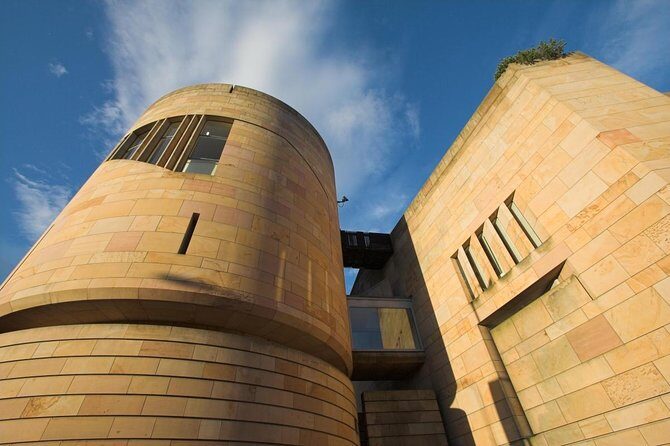
- Lifetime access means you can revisit the route anytime you return to Edinburgh.
- Offline audio, maps, and geodata help you keep moving without relying on mobile data.
- A clear route runs from the Royal Scottish Academy to the Scottish Parliament.
- Architecture-first commentary ties buildings and street layout to the city’s story.
- Flexible pacing lets you linger or skip stops that don’t hold your interest.
- You need the right gear: your smartphone and headphones aren’t included.
Why this Old Town audio walk works for independent walkers
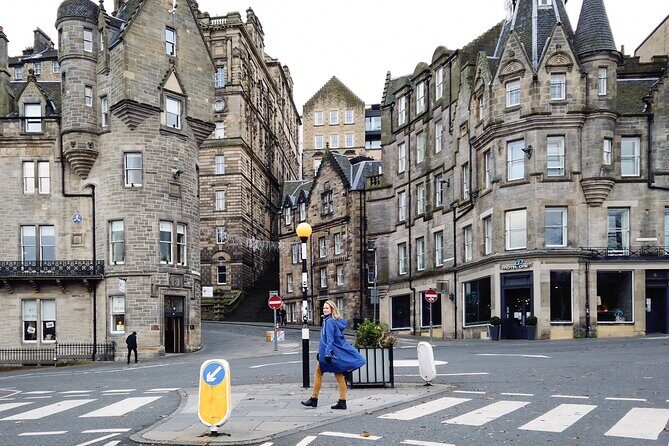
Edinburgh’s Old Town can feel like a choose-your-own-adventure maze. This audio tour works because it gives you both structure and freedom: you get guided prompts as you walk, but you’re not locked into a group schedule.
The route is designed as a straight, walkable thread: you start on The Mound at the Royal Scottish Academy, then work your way through famous Old Town streets and a few lesser-seen stops, finishing at the Scottish Parliament building. That matters because you spend less time “figuring out where to go next,” and more time actually enjoying the walk.
You’ll also notice the tour’s tone. It’s not set up like a museum lecture. It’s built around streets, lanes, and buildings you can see from the sidewalk, with commentary aimed at how Edinburgh’s history shows up in the architecture around you.
Price and value for a reusable guide

The price is $11.99 per person, and the biggest value hook is that you’re not buying a one-time guide. You’re buying lifetime access, which turns this into a reusable “self-tour ticket” for future visits.
It’s also relatively low-commitment. You’re looking at about 1 hour 30 minutes to 2 hours, so it fits into a longer Edinburgh day without swallowing your whole morning or afternoon. And because the tour doesn’t require paid museum entries, you’re not forced into extra costs just to keep the experience going.
That said, you should be realistic about what’s included. Food/drink, smartphone, headphones, and any entrance tickets are not included. If you don’t already own a working phone and earbuds/headphones, factor that into your budget.
VoiceMap setup with offline maps and smart gear needs
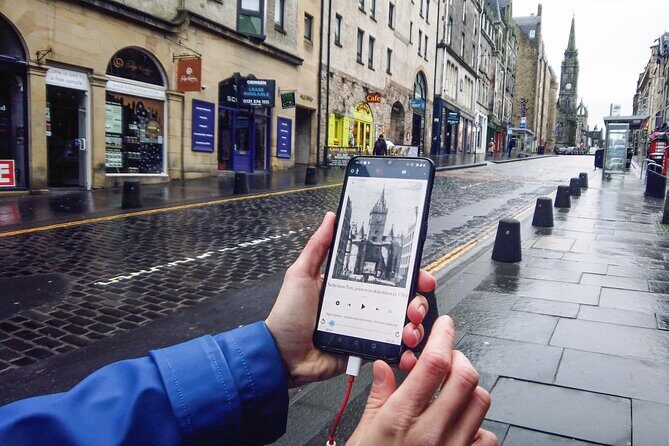
This runs through the VoiceMap app (available for Android and iOS). The tour includes lifetime access, plus offline access to audio, maps, and geodata—so you can save the content before you head out.
Here’s the practical checklist I’d follow:
- Bring a charged smartphone.
- Bring headphones (you can’t count on speaker audio).
- Plan to download anything needed for offline use before you start walking.
Also, go in knowing that audio tours depend on your phone’s positioning. One piece of feedback you should take seriously is that sometimes the app can place you accurately and sometimes it can lag behind. If you notice the map point not matching your exact spot, don’t panic—slow down, check the on-screen map, and walk a few steps until the prompt catches up.
Royal Scottish Academy to Princes Street Gardens: start strong
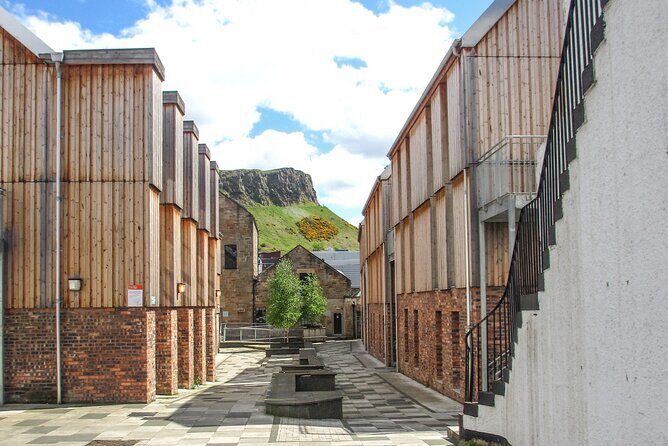
Your walk begins in front of the Royal Scottish Academy on The Mound (Edinburgh EH2 2EL). Before you move, you’ll get a short introduction to the tour and a walkthrough of how the VoiceMap app works. That opener is more than filler—it sets expectations for how you’ll hear guidance as you go and how maps support the audio.
From there, the tour takes you through a section of Princes Street Gardens. This is one of the moments where the tour’s concept becomes clear: you’ll hear about Edinburgh’s history and how that story is represented through the architecture around you. Even though you’re in gardens, you’re still being coached to look at buildings and styles you can see nearby.
The garden segment is also a good “warm up.” It gives you a chance to figure out your pace—how long you need between listening prompts, and whether you prefer to pause and look up at facades or just keep walking.
Royal Mile and the National Museum exterior: seeing the in-between
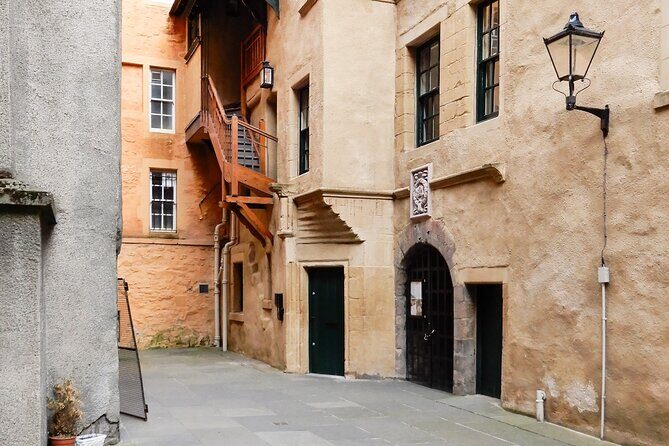
Next comes a stretch down part of the Royal Mile. The narration frames it as the physical and social backbone of the Old Town. That’s useful context because the Royal Mile can otherwise feel like a famous street you just walk down. Here, you’re guided to see why it matters beyond popularity.
After that, you’ll walk around the outside of the National Museum of Scotland. You’re not being asked to buy a ticket or rush inside. Instead, the audio guides you to notice the unusual, lesser-known side of the museum experience—at least from the perspective of what you can see and how the building fits into the surrounding area.
This exterior-focused choice is a real benefit. It keeps your time flexible and prevents the day from turning into a queue-management exercise.
Possible drawback: if you specifically want museum interiors, you’ll be a bit frustrated here. The tour keeps things outside, so you’re using the National Museum as a visual landmark and a story anchor, not as an entry-and-exhibit stop.
Gladstone’s Land and Riddle’s Court: short stops in side streets

You’ll get a brief stop in front of Gladstone’s Land, one of the few buildings on the Royal Mile that dates back to pre-mid 17th century times. The stop is short, but it’s intentional: the audio gives you a quick historical angle you can connect to the street you’re already on.
Then the route turns toward Riddle’s Court, described as a hidden place that was once a merchant’s house. This is exactly the kind of stop that works with a self-guided format. When you’re on foot, side passages and small courtyards can be easy to miss. The audio basically hands you permission to slow down and pay attention.
If you like discoveries that aren’t just big-name monuments, these two stops are a strong part of the experience. They add variety without changing the total walk time much.
One thing to watch: because these are brief audio pauses, you’ll get the most out of them if you keep your phone handy and don’t keep skipping back and forth.
St Giles Cathedral to John Knox House: architecture-focused storytelling

You’ll pass St Giles Cathedral while the audio tells you about its history and some remodellings. The cathedral stop is positioned as a moving moment on the Royal Mile side of the Old Town—less of a “sit here and listen for 20 minutes” situation, more of a “learn while you walk past” experience.
After that, there’s a brief stop in front of John Knox House Museum. The narration focuses on the house’s history and how the building got its name. Because you’re getting only a brief stop, it works best when you’re willing to treat it like an orientation moment: you hear the key idea, then you move on with a better mental map of what you’re seeing.
This section may be the tour’s make-or-break point. The core thread is architecture and built form. If that’s what you came for, you’ll probably feel like the route helps you “read” Edinburgh like a document. If you prefer political history, ghost stories, or lifestyle tales, you might find the emphasis too architectural.
Ending at the Scottish Parliament: finish your walk
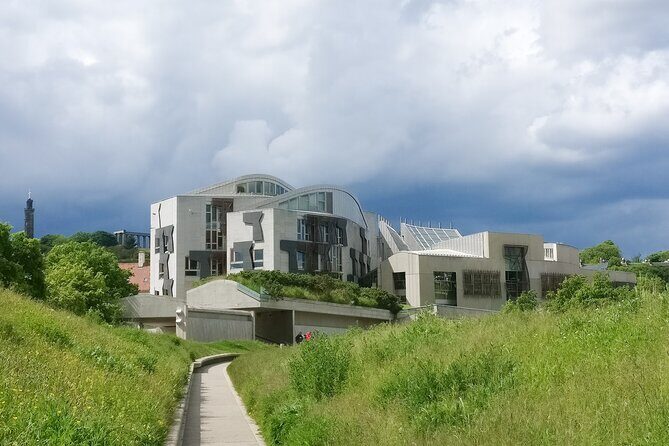
The tour ends in front of the Scottish Parliament building at Horse Wynd (Edinburgh EH99 1SP). The final audio moment covers architectural features, giving you a clean landing point at the end of the route.
Ending at the Parliament is a smart design choice for self-guided tours. It gives you a defined finish line and a landmark that’s easy to recognize when you’re ready to stop listening and start planning what’s next.
After the walk, you’re in a good spot to keep exploring at your own pace. If you want to continue, you can turn the tour into a longer loop by revisiting nearby streets without worrying about “missing the next stop.”
If you want to go straight to coffee or dinner, you’re also set up for that. The tour itself is time-boxed to about 90 minutes to 2 hours, so it won’t derail your evening plans.
Should you book this Old Town audio tour?
Book it if you want an audio guide that’s flexible, budget-friendly, and reusable. The offline access and lifetime access are the two biggest reasons it feels like value, especially if you might revisit Edinburgh within the next few years. It’s also a great fit for people who enjoy learning by looking at buildings and street layout rather than standing in lines.
Skip it (or consider another style) if you don’t like architecture-focused narration. And if you hate tech dependence, take the GPS note seriously: the app can be accurate some moments and not others, so you’ll want to stay patient and let the prompt catch up.
If you’re the type who likes wandering with a light hand on the steering wheel, this tour is a solid match.
FAQ
What is the price of this Edinburgh Old Town audio tour?
It costs $11.99 per person.
How long does the tour take?
Plan for about 1 hour 30 minutes to 2 hours.
Where does the tour start and where does it end?
It starts in front of the Royal Scottish Academy on The Mound (Edinburgh EH2 2EL) and ends in front of the Scottish Parliament building on Horse Wynd (Edinburgh EH99 1SP).
What is included with the tour?
You get lifetime access to the tour in English, plus offline access to audio, maps, and geodata through the VoiceMap app for Android and iOS.
Do I need tickets or museum entrance fees during the walk?
No. Tickets or entrance fees to museums or attractions en route are not included.
What do I need to bring?
You’ll need your smartphone and headphones. They are not included.
Is the tour available offline?
Yes. Offline access to audio, maps, and geodata is included.
Is this tour refundable if I cancel?
No. The experience is non-refundable and cannot be changed for any reason.
Is there a time window for doing it?
The posted opening hours show availability every day from 12:00 AM to 11:59 PM (within the listed date range).
]]>Two things I like right away: the GPS route that helps you stay on track, and the way the tour starts at Writers’ Museum so you immediately connect the city’s books-and-authors vibe to the show. One possible drawback: if you’re chasing exact episode-by-episode scene callouts, you may find the Outlander references feel more thematic than pinpointed—and crowds on the Royal Mile can make stopping to listen harder.
Key Highlights at a Glance
- Audio from Jule (not a computer voice) keeps the walk personal and easy to follow
- GPS + map directions help you find each landmark without a printed script
- Major Edinburgh icons like the Sir Walter Scott Monument and Holyrood Palace are on the route
- Several stops note free admission, so you can keep costs low
- A true end at Holyrood gives you a satisfying finish on the Royal Mile
- Signet Library + afternoon tea option if you want a slower pause inside
What You’re Really Buying: An App-Led Audio Walk With a Human Voice

This is a private, self-guided experience in Edinburgh. You get access to the tour on an app for 3 weeks unlimited, with a map, directions, and a GPS route for each stop. Instead of a robotic narrator, you’ll hear guidance from Jule—real human audio is a big deal on a walking tour, because you’re more likely to actually listen instead of fighting with a flat, one-size-fits-all voice.
The price, $12.49 per person, is low enough that you can treat it like a “starter pack” for Edinburgh’s Old Town without committing to a pricey guided day. You’re also not paying entrance fees inside the ticket price. In other words: it’s built for the outdoors and the look-around factor, with optional add-ons if a stop offers paid entry or food.
The main thing to know is the tour’s style. It connects landmarks to Outlander and to Edinburgh’s Jacobite-era background, but the emphasis leans toward history and locations that inspired the story world, not a blow-by-blow of every filmed scene you’re hoping to spot. If that’s what you want most, plan to be a bit flexible.
Starting at 477B Lawnmarket: Writers’ Museum to Sir Walter Scott
Your tour starts at 477B Lawnmarket, Edinburgh EH1 2NT, and it’s designed for you to get moving fast. The first stop is the Writers’ Museum—the tour frames it as the perfect opener because Outlander began as a book series before it became the TV sensation. Even if you don’t go inside, the surrounding square area sets the tone: Edinburgh as a city where stories matter.
The Writers’ Museum stop is listed at about 10 minutes, with free admission ticket noted in the tour description. If you do step in, you’re likely to get a quick literary hit that makes the rest of the walk land better. If you skip it, you still start in the right mental place: Edinburgh as authors, manuscripts, and imagination.
From there, the route heads to the Sir Walter Scott Monument, described as the largest monument to an author anywhere in the world. Scott’s novels tied closely to the Jacobite uprisings, which is exactly why this stop matters on an Outlander-themed route. It’s a good moment to reframe what you’re doing: you’re not only hunting for show scenery—you’re also looking at how 18th-century history got retold and reimagined into later culture.
Signs, Squares, and the Heart of Midlothian: Where the City Feels Like the Story
After the monument, you move to the Heart of Midlothian. This is the sort of landmark that works whether you’re a hardcore fan or a first-time visitor, because it sits at the center of Edinburgh’s identity. The tour points out why it’s important to both the city and Outlander, which makes this stop more than a photo stop. You’re meant to connect the show’s emotional geography to real local landmarks.
Next comes a big practical win: the Colonnades at the Signet Library. This is your first Outlander filming location on the tour. The tour also notes that the Signet Library is open for afternoon tea, so you can turn a quick pause into a planned rest. That’s useful because Edinburgh’s Old Town can be hard on your feet if you keep moving nonstop.
The time listed here is about 15 minutes, with free admission noted for the stop itself. If you’re the type who needs a sit-down break, this is a great place to do it—if you’re curious what the inside looks like, you can likely plan a tea stop around your timing.
From the Signet Library, you’ll reach Parliament Square, explained as “because of the building opposite the cathedral,” and identified as the site of Scotland’s parliament meeting until 1707. The point of this stop on an Outlander route is that story power often comes from the tension between who had authority and who didn’t. Even if you’re only half-following the history, this area helps you feel the weight of the era.
Mercat Cross, Unicorns, and a Courtyard That Teases a King

Edinburgh loves symbols, and you’ll see them here. The Mercat Cross is described as the structure with the unicorn on top of the pillar. It’s also framed as a longtime market marker, with a Mercat Cross standing since 1215 (with the original described as wooden). For Outlander fans, Scott/Jacobite-era context matters, but symbol-rich places help you imagine the past crowding back in.
The tour suggests you’ll learn why this landmark matters to the city and to the TV series. The practical reason to care is simple: Mercat Cross is one of those “you’re in the right spot” Edinburgh anchors, so you can orient yourself in the Old Town while you listen.
Then you’re off to Tweeddale Court, another courtyard stop. Here’s where the tour leans into the interactive game feel: you’re told to guess what it was used for and in which season, with history tied to the Jacobites and a specific king (without you needing to know everything in advance). This is one of those moments where the audio guide’s story framing matters more than any single landmark detail, because courtyards can look similar until a script tells you what to look for.
If you’re walking in busy hours, courtyards can be tricky. People flow in and out, and you may not get much quiet time. In that case, keep your expectations realistic: you’re listening while moving through a real, used space—not a movie set.
Calton Hill: Fairy Tales, Parthenon-Like Pillars, and a Viewpoint Pause
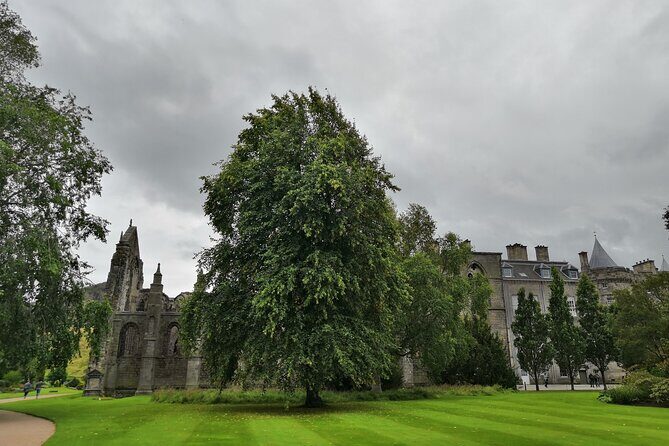
The next big change in the route comes with Calton Hill. The tour describes it as the hill on the other side of the valley, with a castle-like structure on top. It also hints that if you look to the right, you might spot stone pillars resembling the Parthenon in Athens.
That matters for your mental image. Edinburgh’s Old Town is all tight closes and historic streets. Calton Hill gives you an open-feeling break—plus the chance to see how Edinburgh’s look ties into the broader British habit of borrowing classical shapes. The tour also calls it Edinburgh’s Faerie hill and connects local tales to Outlander, with historical importance included as part of the explanation.
Time on this stop is about 10 minutes. That’s enough time to look around, get a few photos, and reset before heading back down into the thick of the Royal Mile.
Old City Gates by Pub and Golden Cobblestones: The Netherbow Port Route Clue

After Calton Hill, you’ll find another very Edinburgh detail: a pub marks the old city gates. The tour tells you that if you look toward the middle of the road, you can see the old gates called the Netherbow Port, outlined in golden cobblestones.
This is a great example of why an audio route helps: you might walk past the Netherbow Port without noticing it. With guidance, it becomes a story clue. The tour also points out that if you follow St Mary’s Street, you can reach some of the last remaining parts of the Flodden Wall. That turns one “wait, what is that?” moment into a longer thread of context.
For a practical tip: when a tour gives you “look down the road” directions, take those seriously. Stand where the guide tells you to stand, then scan with your eyes before you start walking again. It will save time and prevent the frustrating back-and-forth that happens when you move too quickly.
Canongate Kirk: Royal Worship Since the Glorious Revolution
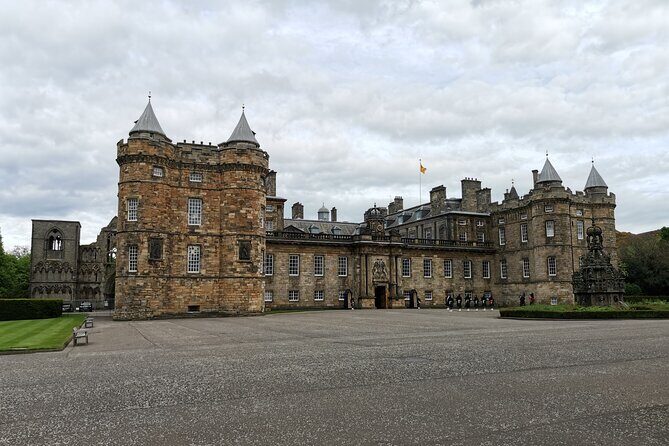
Your next stop is Canongate Kirk, described as Edinburgh’s royal church associated with the royal family since the Glorious revolution in 1688. The tour also adds a specific, memorable detail: when Queen Elizabeth II visited Edinburgh on her yearly visits, this is where she would worship.
This is the sort of fact that helps you feel the difference between “a historic building” and “a building with ongoing ceremonial importance.” On a walking tour, it’s easy to think history is dead and finished. Stops like Canongate Kirk bring it back to life because the royal connection is explicit.
The scheduled time is about 10 minutes, with free admission noted for the stop. Even if you only view it from outside, the story behind the building helps you read it properly. If you do enter, just know you’ll need to match your pace to any crowding around the church.
Bakehouse Close (Carfax Close): The One Alley Fans Will Hunt
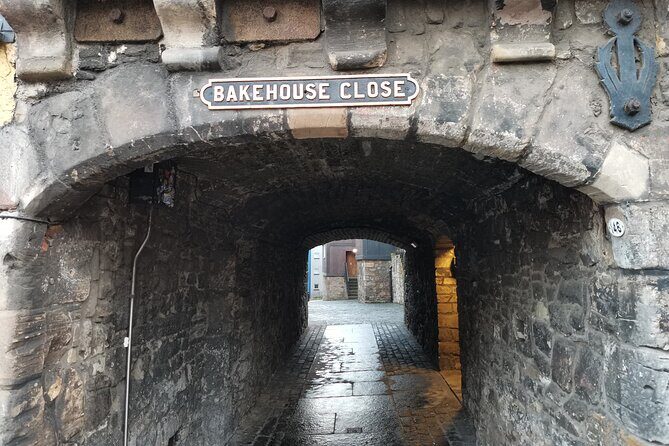
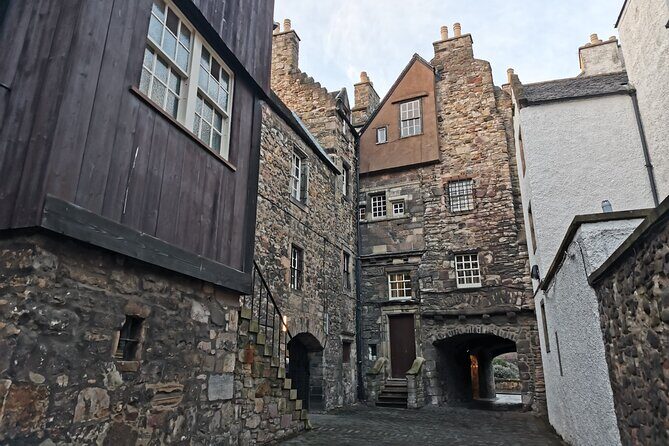
Then you hit one of the most fan-famous moments on the route: Bakehouse Close, described as an alley you may recognize from Outlander, where it’s called Carfax Close in the series. The tour positions this as an emblem of Outlander in Edinburgh, and it explains the historical significance plus its parallel story to Jacobite uprisings.
The listed time is about 10 minutes, with free admission noted. This stop is also where practical navigation matters. One issue you might run into on self-guided tours is that alleys can be easy to miss if foot traffic is heavy or if your phone is struggling with signal. On days when the Royal Mile feels packed, pause longer than you think you need just to confirm you’re entering the right close.
If you want the best chance of enjoying this part, aim for a quieter time of day. Short stops are only enjoyable when you can actually stand still long enough to let the audio guide do its job.
Finishing at Holyrood Palace: The Royal Seat and the Outlander Payoff
The tour ends at The King’s Gallery, Palace of Holyroodhouse, Canongate The Royal Mile, Edinburgh EH8 8DX. It’s a strong finish: Holyrood Palace is described as the Scottish royal seat, and the tour notes that the king or royal family stays there when visiting Edinburgh.
The route ties Holyrood to Outlander in the books and series. You’re also prompted with a question in the audio: which King is named to hold residence in the palace at that time? That question style works well because it turns the ending into a final “did you catch it?” moment, instead of a random stop where the tour simply stops.
Time here isn’t specified beyond the overall tour duration, but the practical lesson is clear: save enough energy to finish at a proper vantage point. Holyrood’s area can be calmer than the hottest stretch of the Royal Mile, but it’s still central.
If you want to extend your day, this finish location is ideal. You’ll be right where it’s easy to keep wandering Old Town streets, pop into nearby shops, or find a proper meal after your hour or two of story-hunting.
Price and Timing: Does $12.49 Deliver Real Value?
At $12.49 per person, the value comes from how the tour is built. You’re paying for:
- 3 weeks of app access (you can redo it without buying another ticket)
- map + GPS guidance
- audio by Jule (human narration is a plus)
- a tight route of major landmarks that mostly work from the street
That’s a good deal if you enjoy walking and want structure without paying for a live guide’s hourly cost. It’s also a solid match if you’re traveling with flexibility—you can stop longer at spots that catch your eye and move quicker through places that don’t.
The trade-off is that self-guided tours depend on you. When crowds build, it’s harder to stop at the perfect moment and focus on listening. And if you’re specifically hunting for exact show scenes tied to specific episodes, you may have to do some of that matching yourself.
Overall, I see this as good value for people who like history, symbolism, and story atmosphere—people who want to wander the “what shaped the book and show world” part of Edinburgh.
The Best Way to Use This Tour (So You Don’t Miss the Point)
To get the most out of the experience, treat the stops like layers, not checkboxes.
- Keep your headphones ready and expect short listening moments at each landmark.
- When directions say to look for something (like the golden cobblestones outlining Netherbow Port), slow down and confirm first.
- If you care about Outlander details, listen closely at the stops specifically described as filming locations or as alleys tied to Carfax Close.
- Bring comfy shoes. This is a walking route with “moderate physical fitness level” guidance, and Edinburgh’s uneven streets will do the rest.
If you’re the type who gets distracted by people, you might do best starting earlier in the day when the Royal Mile feels less like an obstacle course. You can still follow the audio, but you’ll feel less rushed.
Should You Book This Edinburgh Outlander Self-Guided Private Tour?
Book it if you want a low-cost, structured way to see major Old Town landmarks while connecting them to Outlander themes and the Jacobite-era context behind the story. The combo of GPS navigation and Jule’s audio is a strong match for travelers who like independence but still want their day to have a plot.
Skip it (or go in with eyes open) if your main goal is to match each stop to a specific episode scene in a very exact way. This tour feels built to connect places to the wider story world. It’s still fun, but it’s not marketed like a scene-by-scene filming-location hunter.
If you’re somewhere in the middle—Outlander fan and Edinburgh-history lover—this is a smart, affordable way to spend 1 to 2 hours on the Royal Mile.
FAQ
How long does the Edinburgh Outlander self-guided tour take?
It’s listed as about 1 to 2 hours.
What does it cost?
The price is $12.49 per person.
Who provides the audio guide?
The tour audio is guided by Jule, and it is described as not using a computer-generated voice.
Do I need to pay entrance fees at the stops?
Entrance fees are not included. That said, some stops in the route note free admission options.
Where do I start and where does it end?
You start at 477B Lawnmarket, Edinburgh EH1 2NT and end at The King’s Gallery, Palace of Holyroodhouse near the Royal Mile in Edinburgh.
Is this a private tour for my group only?
Yes. It’s described as private, with only your group participating.
How does the self-guided part work?
You activate the tour using instructions sent by email, then follow the map, directions, and GPS route in the app with audio, videos, and pictures.
Is the tour available in English?
Yes, it’s offered in English.
Can I get a refund if I cancel?
No. The experience is non-refundable and cannot be changed for any reason.
What fitness level do I need?
The tour notes a moderate physical fitness level.
]]>I especially like the pacing and the fact that you’re not stuck with a big bus vibe. Private transportation and live commentary on board keep the background coming, and then each stop gives you a tangible link to Mary’s life—from baptism and crowned years to a retreat with very specific, visitable details. The one catch to plan for is cost at the gates: the big sites (Linlithgow Palace, Stirling Castle, Falkland Palace) have admission fees not included, so you’ll want extra budget and a little patience.
Key Highlights Worth Booking
- Marie Stuart Society connection gives the biography extra grounding and context
- Free MQS Edinburgh self-guided tour extends the experience beyond your day trip
- Mary’s route in four stops moves from birthplace to childhood crown years to a retreat
- St. Michael’s Parish Church details include visible marks connected to Cromwell’s men
- Falkland Palace garden specifics include the oldest tennis court in the UK
What You Get: Private Transportation, Live Commentary, and a Free MQS Edinburgh Tour
This is a private, full-day tour built around one question: how did Mary’s story shape Scotland, and how do you see that story in real places? You start in Linlithgow and end back where you began, with a driver/guide handling transport and live commentary so you’re not reading lonely plaques while you’re traveling.
In practical terms, the value is in three layers. First, you get bottled water, so you can concentrate on the day instead of scrambling for drinks. Second, you get a guide who’s part of the Marie Stuart Society, which matters because it turns “old castles” into a coherent narrative. Third, the tour includes a free self-guided MQS Edinburgh tour with all bookings. That add-on is a smart move for anyone with only one or two days in the Edinburgh area—because you can keep exploring Mary’s footprints after the bus ride is over.
You’ll also get a mobile ticket, which is convenient for day-of logistics. And since it’s private, the pace is generally easier to manage if your group likes photos, asks questions, or needs a moment to catch your breath.
Meeting Point in Linlithgow: Your 9:00 AM Start and an 8-Hour Plan
The tour starts at Station Rd, Linlithgow EH49 7DH at 9:00 am, and it ends back at the same meeting point. That loop matters: you’re not spending time crossing the city and rerouting at the end. You can treat the day like a focused “royal route” rather than a scattered series of stops.
The overall time is about 8 hours, so plan for a long day. It’s not a hike-heavy outing, but you should have moderate physical fitness. Expect walking through historic spaces, standing for short stretches of commentary, and moving at a pace that fits a castle-and-palace schedule.
One helpful detail: the meeting location is described as near public transportation, so if you’re traveling into Linlithgow on your own, you should have workable options. Service animals are allowed too, which is good to know for planning.
Stop 1: Linlithgow Palace, Mary’s Birthplace and the Marie Stuart Society Statue
Your day begins at Linlithgow Palace, with the focus on the moment Mary entered the world in 1542. This is the “why this story starts here” stop. Even if you’ve read about Mary already, it hits differently when you’re standing in her birthplace setting and hearing the timeline tied to Scotland’s court life.
A standout detail here is the new statue funded by the Marie Stuart Society. That’s more than a photo opportunity. It signals that the story is still actively cared for and interpreted—not just preserved behind glass. For many visitors, it becomes an anchor: you can look around and understand that your later stops (baptism, childhood crowning years, and eventually a retreat) are not random sightseeing. They’re chapters.
Practical note: Linlithgow Palace entry/admission isn’t included, so you’ll want to factor in the cost and time at the gate. The stop is about 1 hour, so you can’t expect to linger forever in one room. If you like reading every sign, you may need to skim and prioritize what you care about most.
Stop 2: St. Michael’s Parish Church, Baptism, Stained Glass, and Cromwell’s Marks
Next up is St. Michael’s Parish Church for Mary’s baptism setting. This is one of those stops that feels quieter than the castles, but it’s often more emotionally sharp. The church is described as medieval with stunning stained glass windows, which gives you a strong sense of the visual culture of the time.
What makes this stop memorable is that it includes physical evidence connected to later conflict. You can see lasting marks left inside and outside the church tied to Oliver Cromwell’s men. That matters because it turns history into something you can literally point at. You’re not just hearing about events—you’re seeing how they left a trace.
The stop is about 30 minutes, and admission is free. That combination is great if you want a stop that doesn’t swallow your day. It’s also a nice rhythm change after the palace beginning: you go from royal birthplace context into a religious space tied to Mary’s early life.
Stop 3: Stirling Castle’s Royal Apartments, Childhood Crown Years
After Linlithgow and the church, you head to Stirling Castle for what is arguably the dramatic centerpiece of the day. You’ll spend about 2 hours here, and it’s time well spent because the focus is specific: Mary’s young life as well as the setting where she was crowned.
The highlights are the Royal Apartments, described as beautifully restored, where Mary lived as a young child and where she was crowned. This is the part of the story where Mary stops being a name in a book and becomes a person inside a real royal environment. You get the “so this is where power was staged” feeling—space, ceremony, and the kind of rooms where decisions would have been made.
As with the other major sites, Stirling Castle admission isn’t included, so plan for ticket costs on top of the tour price. It’s also one of those places where you’ll want to arrive mentally ready to walk a bit and take in a lot of visuals. Two hours is a decent chunk, but if your group is super photo-focused, you may feel it move fast.
Tip that helps most people: if you’re interested in Mary’s story specifically (not just castle sightseeing), ask your guide to point out the spaces most tied to her crowned years. That prevents you from leaving with lots of general memories and not enough Mary-specific ones.
Stop 4: Falkland Palace and Garden, Mary’s Retreat and the Oldest Tennis Court in the UK
Your final stop is Falkland Palace & Garden, and it’s a fitting ending because it connects to Mary’s quieter, more personal life. The day shifts from ceremony and court power into a place described with reconstructed rooms from Mary and beautiful gardens.
This is also where you get one of those unexpectedly fun details: the oldest tennis court in the UK is here. That sort of information is why I like this tour style. You walk away with at least one fact that feels uniquely “Falkland,” not like every other castle you’ve seen.
The stop is about 1 hour, which keeps it from dragging, and the tour aims to end at one of Mary’s favorite retreats. That framing matters, because it gives the whole day a sense of completion: birthplace, early faith setting, childhood crowning years, and then a restorative retreat atmosphere.
Just like the other big sites, Falkland Palace admission isn’t included. Budget for it, and if you’re sensitive to weather, bring layers. Gardens can be lovely or brisk depending on the day.
Price and Logistics: What You’re Paying For (and What You’ll Pay Extra)
The price is $1,197.61 per group (up to 6) for an approximately 8-hour private tour. That’s not cheap in absolute terms, but private, guided historic touring in Scotland often prices this way because you’re paying for transportation, a live guide, and a day that’s built around your group rather than a public schedule.
Where the value comes in for this specific tour:
- You get a local guide connected to the Marie Stuart Society, not just a generic narration voice.
- Private transportation saves you from stitching together trains and taxis across distant sites.
- Live commentary on board helps you understand what you’re seeing while you’re traveling.
- A free self-guided MQS Edinburgh tour meaningfully stretches your time in Scotland.
What’s not included (and why it matters): admission fees for Linlithgow Palace, Stirling Castle, and Falkland Palace. If your group includes several adults, these tickets can add a chunk. The tour’s base price covers the guided experience and transport; your gate admissions cover the sites themselves.
Also note that lunch isn’t included, so plan your own food strategy. With stops spaced across different towns, it’s smart to bring snacks or plan a sit-down somewhere flexible. You’ll have a better day if you don’t rely on finding food at exactly the wrong moment.
Timing: How to Make the Day Feel Smooth (Not Rushed)
A tour day that starts at 9:00 am can either feel efficient or frantic. Here, the key is to treat it like a full-day circuit. You’ll likely have a steady rhythm: short to medium stops (30 minutes at the church, 1 hour at Linlithgow, 2 hours at Stirling, 1 hour at Falkland) and travel between them with guided commentary.
Because admissions aren’t included, you’ll want to decide in advance how you’ll handle tickets:
- If you prefer minimal stress, you can budget time at each stop for ticketing.
- If you want maximum history time, be ready to enter quickly and focus your attention on Mary-related rooms and details.
Weather matters too. The experience notes that it requires good weather. That’s common for gardens and castle grounds. If the day turns damp (Scotland loves drama), have a plan for layers and comfortable shoes.
Who This Tour Suits Best
This is a strong fit if you:
- Want a Mary Queen of Scots-focused day rather than general Scotland sightseeing
- Like talking with a guide who can answer follow-up questions
- Prefer private pacing over crowd management
- Appreciate seeing how one person’s life connects different places
It may be less ideal if you:
- Have a strict budget and don’t want to add castle/palace admission fees
- Are hoping for a slow, roaming day with no schedule pressure
- Need a very short outing (this is about 8 hours)
One more reason I think it works well for couples, friends, or small families: up to 6 people means it’s private but still flexible. You can keep the group together while still moving at a pace that makes sense for your interests.
Real-World Value: What You’ll Remember After
What sticks with me most about this style of tour is how it uses place to tell a sequence. You start at the birthplace setting, move into early religious life, then into childhood and crowning years, and end with a retreat atmosphere plus garden details like the tennis court.
Also, your “day trip” doesn’t disappear after the car ride. The free self-guided MQS Edinburgh add-on gives you a second pass at Mary’s story while you’re in Edinburgh. That’s great if you want to build your own path through the city at your own speed instead of cramming everything into one day.
If you’re into pop-culture tie-ins or want the story connected to later Scottish storytelling, you may find the guide willing to tailor the focus. One private tour experience with Ann included adding Mary-related and broader Scottish queen sites alongside places tied to popular TV storytelling themes. So if that’s your thing, it’s worth asking.
Should You Book This Private Mary Queen of Scots Tour?
Yes—if your goal is a guided, Mary-centered day that also gives you extra exploration time in Edinburgh. The guide connection, the private format, and the free self-guided MQS Edinburgh tour create real added value, especially for groups up to six.
I’d book it when you’re comfortable with two realities: you’ll pay site admissions separately, and you’ll spend a full day on the move. If that fits your style, you’ll come away with the sense that Mary’s life isn’t just a biography—it’s a trail you can walk.
FAQ
What is the tour price and group size?
The price is $1,197.61 per group for up to 6 people.
How long is the private Mary Queen of Scots tour?
It runs for about 8 hours.
Where do we meet, and when does the tour start?
You meet at Station Rd, Linlithgow EH49 7DH, UK, and the tour starts at 9:00 am. It ends back at the meeting point.
Is lunch included?
No, lunch is not included.
Are admission tickets included for the main sites?
No. Admission is not included for Linlithgow Palace, Stirling Castle, and Falkland Palace & Garden.
What is included in the tour price besides the guide?
Bottled water, a driver/guide, live commentary on board, private transportation, and a free self-guided MQS Edinburgh tour with all bookings.
Is there free cancellation?
Yes. You can cancel for a full refund up to 24 hours before the experience’s start time.
]]>What I like most is the mix of famous places and free-to-view stops, so your money goes to the experience, not constant ticket lines. I also like the practical app guide: maps, directions, and a clear route built around what you will see, with videos and photos to help you recognize what you’re standing in front of.
One thing to weigh before you go: admission is not included for a few of the major stops, including Edinburgh Castle, so you should plan on extra costs if you want to enter those sites.
Key points at a glance

- Audio guide by Jule that is not computer-generated, plus videos, pictures, and recommendations
- GPS route and stop map that helps you stay oriented through the Old Town maze
- Royal Mile basics: it is actually four streets, from Castlehill/Lawnmarket to High Street/Canongate
- A myth-versus-reality moment at St Giles, centered on the cobblestone heart in the street
- Several truly free stops paired with a few sights where admission is not included
- Private experience for just your group, with time to go at your own speed
How this self-guided Edinburgh Old Town tour really feels
This tour is designed for pacing that actually matches how you travel. Instead of being rushed by a group schedule, you follow a marked route on the app, stop where it tells you to, and spend as long as you like on the details that grab your attention. The whole experience is built around an approximately 2 to 3 hour walk, which is a sweet spot for Edinburgh’s Old Town: long enough to feel like you saw a lot, short enough that your feet don’t fully file a complaint.
You start at a very practical landmark: Loch Ness Discovery Centre on Parliament Square (192 Parliament Sqr, High St). That matters because Parliament Square is a handy “center point” for Old Town navigation. The tour ends at Deacon Brodies Tavern on Lawnmarket, which is a good spot to keep wandering without worrying you will be stranded back at the start.
Logistically, the tour runs on app access for three weeks unlimited, so you can take your time preparing before you go. And because the audio is guided by Jule (not a synthetic voice), the tone stays more human and easier to listen to while you’re walking.
Physical note: Edinburgh’s Old Town includes cobbles and uneven ground. The tour calls for moderate physical fitness, so it’s best if you’re comfortable on foot for a couple hours.
Starting on Parliament Square: the perfect launchpad

You begin on Parliament Square, not randomly on a side street. That helps because the next segments of the walk are tied to Scotland’s governance story—how Parliament in Scotland fits into the broader Scotland-and-England backdrop. Even if you already know the headline version, the tour’s approach is geared toward making the timeline and the connections make sense as you move.
This is also where you’ll feel the “why” of Old Town geography. Parliament Square sits in the same general world as the Royal Mile, City Chambers, and St Giles, so your route naturally climbs and descends through the Old Town power spine. You’ll be walking through places that aren’t just pretty; they’re tied to civic life, religion, and public events.
If you’re the kind of traveler who likes to know what you are looking at (and not just see it), the start is a good match. If you just want scenic photos with minimal context, you can still skim the audio parts and keep moving.
Tip: give yourself a few minutes at the very start just to start the app and confirm you’re on the right GPS track. That way your first stop lands smoothly and you don’t spend your best energy on tech fussing.
The Royal Mile: why it’s one street name, but four actual streets

The tour’s first real highlight stop is the Royal Mile, which is one of those Edinburgh things that sounds simple until you learn it’s slightly sneaky. The Royal Mile is made up of four different streets: Castlehill and Lawnmarket at the top, then High Street and Canongate further down.
You will learn why it earned the title Royal Mile, and you’ll get the sense of how this is Edinburgh’s main walking spine. Historically, Royal Mile areas concentrate visitors, institutions, and power moves—so the stories you hear here give you a framework for the rest of the walk.
Why I think this stop works so well: it turns an overwhelming stretch of shops and stone lanes into something you can follow. Instead of thinking you’re just wandering between highlights, you start to feel you’re moving along a set of connected corridors.
How long to spend: the scheduled stop is brief (around 10 minutes), but you can extend it easily because the Royal Mile is the kind of place where you’ll spot details mid-walk—signs, closes, corners—that the audio may not fully cover. Use the audio as a backbone, not a cage.
City Chambers and Mercat Cross: civic power and medieval public life

Next up is the Edinburgh City Chambers, built in 1760 and still tied to city governance as the meeting place of the City of Edinburgh Council. It’s also a popular wedding spot, which is a fun reminder that these buildings aren’t just museum pieces. They still function in everyday Edinburgh.
The value here is not only architecture—it’s meaning. When you understand that City Chambers sits at the intersection of politics and public life, it becomes easier to see why Edinburgh’s civic landscape feels so formal. Even the wedding connection helps: you’re standing where people make real-life decisions, not just reenact history for photos.
Then you move to Mercat Cross, where the original structure dates back to the 12th century. The audio explains how Mercat Cross was once the place for medieval punishments, and why the spot still matters as an emblem of the city.
That contrast is the point. Edinburgh doesn’t only do royal pageantry; it also has a past that includes harsh public spectacle. Seeing it in one of the Old Town’s key public nodes makes the story land fast. You get the shift from medieval public life to modern identity, and you understand why today’s visitors treat the area as symbolic rather than merely historical.
Parliament’s story and John Knox: politics and faith on the street
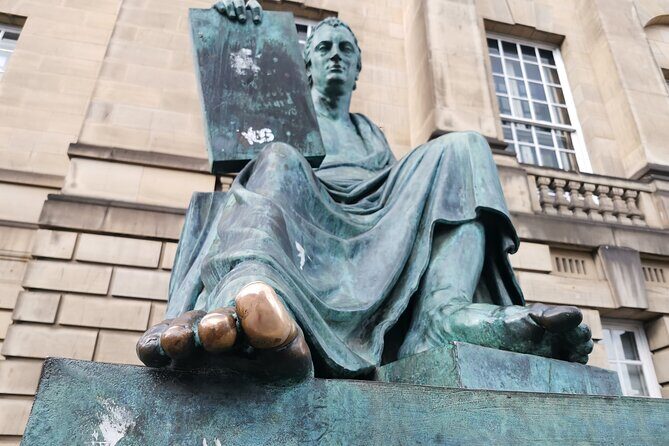
As you continue, you’ll reach stops focused on the relationship between Scotland and England, plus how Parliament in Scotland still exists. The audio is built to explain the past and connect it to the present, so you can walk away with a clearer idea of how the political structure evolved.
Right after that, you’ll hear about John Knox and his relationship to the city of Edinburgh. Even if you only know his name from school, the tour’s framing helps you place him geographically and historically, so you’re not just collecting a name—you’re connecting it to the kind of Edinburgh that produced religious change.
I like this section because it’s not “facts only.” It’s geared toward understanding. You’re standing in a place where politics and religion mattered directly, not just as distant ideas.
If you want to get the most out of it, listen at normal volume and avoid reading-only mode. These parts are better when the audio is your guide while your eyes scan the buildings around you.
St Giles Cathedral and the cobblestone heart: myth vs reality

St Giles Cathedral is a must-stop in any Old Town visit, and this tour treats it with the kind of context that makes a church visit feel less like a checklist. The cathedral is named after Saint Giles (b. 650–d. 710) and the church’s origins date back to the 12th century.
But the clever part is what happens next. The tour includes an explanation focused on what’s true and what’s legend about the cobblestone heart in the middle of the street. You’re not just hearing about the building—you’re learning how a tiny urban detail became a story people pass along.
This is one of the best sections for travelers who like real-world texture. Edinburgh can feel like it’s all grand monuments and dramatic angles. This part brings you down to street-level meaning: the kind of detail you might miss if you were only scanning for big photos.
How long: the cathedral stop is scheduled around 10 minutes. If you’re the type to look up at architecture and then look around for small clues, consider adding another few minutes on your own after the audio finishes.
The Hub: a church you can spot from all around

One stop that’s easy to enjoy even if you’re not a big church person is The Hub. The tour explains why it is such a defining part of Edinburgh’s view and tells you the story in a way that’s meant to stick.
The big practical advantage here is that it’s the kind of sight you can still appreciate even from distance—because it is described as visible from all around. That means you can connect what you’re seeing now with what you’ll see later without needing perfect sightlines.
Admission is not included for this stop, so if you want to go inside, you’ll need to plan for the ticket cost separately. If you prefer to keep costs down, you can still use the audio for context while taking in the exterior and surrounding views.
Edinburgh Castle and Castle Rock: longest-inhabited stories

Then comes Edinburgh Castle, perched on Castle Rock. The tour’s angle is about settlement and continuity: the castle is described as the longest-inhabited place in Edinburgh, and the audio focuses on the stories behind that long human presence.
This is a strong mid-to-late tour stop because you’ll have already learned some civic and historical framing by now. That makes castle stories land better. You’re not hearing random trivia; you’re connecting the castle to a wider Old Town timeline.
The scheduled time at this stop is about 10 minutes, but castle visits are naturally variable because visitors often want photos, viewpoints, and indoor exploration. Admission is not included in the tour price for the castle, so decide early how you want to handle it. If you enter, expect to spend more than the audio window suggests. If you don’t, you can still enjoy the external viewpoint and context.
Grassmarket: where the energy and the past overlap
After the higher drama of the castle area, the route drops you into Grassmarket. The tour focuses on past stories and why this area became such a lively, tour-focused venue.
This stop works because it offers contrast. Edinburgh’s Old Town can feel heavy with stone seriousness. Grassmarket shifts the mood. The audio keeps it grounded by tying the lively atmosphere back to its earlier role and history, so you don’t only feel like you’re in a themed street. You feel like you’re in a place that kept changing with the city.
Time here is short (around 10 minutes), which is good because Grassmarket is the kind of location where you might want to wander a little after the tour ends anyway. If you do, just don’t forget the rest of the route is designed to keep moving toward the south side of the Old Town.
Princes Street Gardens, the Walter Scott monument, and UNESCO literature vibes
From Grassmarket, you get the payoff toward the edges of the Old Town. Across Princes Street Gardens, you’ll spot a huge Gothic spire: the Sir Walter Scott Monument. The tour explains why it is there and notes that it is the largest monument to an author anywhere in the world.
That stat gives this stop a hook. It turns a skyline view into a story about how Scotland honors writers. And it’s not just pride—it ties to Edinburgh’s reputation as a place where literature has deep roots.
Next is the Scottish Writer’s Museum, where you’ll learn about three famous Scottish writers featured there. You’ll also hear why Edinburgh was named the first UNESCO World Literature City in 2004, and how authors have kept making the city home over time.
If you like your history delivered through culture instead of politics, this is a great segment. It’s also a good place to catch your breath for a moment—your ears get a narrative break after all the stone-and-state talk earlier.
Admission is not included for this stop, so again: if you want the interior museum experience, budget extra.
The most famous dog in Scotland: a sweet final story
The tour finishes with a lighter note: the story behind the most famous dog in Scotland. The listing doesn’t give a name in the details you provided, but the point is clear: it’s a people-and-place story, ending on something warm and memorable instead of another strict historical lecture.
This kind of finale is smart. It leaves you with a story you can tell later, and it gives you a reason to keep noticing small details around you as you wander the Old Town after the tour ends.
The tour ends at Deacon Brodies Tavern on Lawnmarket. That location choice is handy because it sits right where you can keep exploring nearby closes and viewpoints without feeling like you must jump straight back onto transit.
Price and value: why this costs so little
At $12.26 per person, this is one of the rare Old Town experiences that can fit even tight budgets—especially because many stops are free to access. Several listed highlights come with free admission, including places like the Royal Mile start area, City Chambers, Mercat Cross, and St Giles Cathedral. A few notable stops do have admission not included (The Hub, Edinburgh Castle, and the Scottish Writer’s Museum), so you should plan for those if you want full entry.
But even with possible add-on tickets, the value is strong because you’re buying structure, orientation, and audio storytelling—not just walking between sights. The GPS route, the map and directions, and the app library with three weeks unlimited access are what make the price feel fair. You can treat it like your Old Town “home base guide,” even if you end up going a bit off-script for photos and detours.
Also, since it’s private for your group, you’re not paying per person for a packed, hurry-up experience. It’s built for your pace.
One practical caution: the tour is non-refundable and cannot be changed, so if weather turns truly ugly, you are taking that risk. Edinburgh weather can be dramatic, and self-guided is only as good as your willingness to walk in it.
Who should book this Edinburgh Old Town self-guided tour
This tour is a strong fit if you want:
- A 2 to 3 hour walk that feels focused, not random
- A self-guided way to learn key details about Old Town landmarks
- An audio experience led by Jule, with visuals and recommendations in the app
- A route that includes both free sights and a few paid entry options you can choose to include
It’s especially useful if you’re traveling with people who want slightly different paces, or if you simply hate being trapped in a group timeline. It also suits first-time visitors who want the main historic spine without needing to book multiple separate tickets.
If you want a fully hosted day with no decision-making at all, then a live guide may be a better match. Here, you guide yourself—your phone and the audio do the explaining.
If your priority is only photos and viewpoints with minimal reading/listening, you might find you don’t use all the audio. But if you like context while you walk, this is built for you.
Should you book it
I’d book this if you want a smart, inexpensive way to understand Edinburgh’s Old Town as you walk through it. The combo of GPS route, real audio guidance by Jule, and a set of landmarks that move from civic life to religion to castle stories to literature is a good match for most visitors.
I would hesitate only if you know you won’t want to pay for entry at a few major stops like Edinburgh Castle and the museum options. Also consider the non-refundable rule if your trip dates are tied to a high-risk weather window.
If you like walking tours that let you control the pace, and you want real context without a lecture style, this one is worth your time.
FAQ
FAQ
How long is the Edinburgh Old Town self-guided tour?
The tour is listed as approximately 2 to 3 hours.
Where does the tour start and where does it end?
It starts at Loch Ness Discovery Centre, 192 Parliament Sqr, High St, Edinburgh EH1 1RF, UK, and ends at Deacon Brodies Tavern, 435 Lawnmarket, Edinburgh EH1 2NT, UK.
Is this tour offered in English?
Yes, it is offered in English.
Do I need to pay for attraction tickets during the tour?
Some stops are free, while others have admission not included. Admission not included is specifically noted for The Hub, Edinburgh Castle, and the Scottish Writer’s Museum.
What’s included with the tour purchase?
You get 3 weeks of unlimited access to the self-guided tour in the app, plus a map, directions, GPS route and stops. The app includes an audio guide (with Jule), videos, pictures, recommendations, and all the information you need.
Is there an in-person guide?
No. This is a self-guided experience, and it does not include an in-person guide.
Is it private or shared?
It is private. Only your group participates.
Is the tour refundable if I can’t go?
No. The experience is non-refundable and cannot be changed for any reason.
When is the tour available?
The listed opening hours are Monday through Sunday, 12:00 AM to 11:30 PM, within the stated date range.
]]>What makes it practical is that you control the pace. You’re walking about 2.3 miles, and on average it takes 2.5 to 3.5+ hours, depending on breaks and shopping stops. I also love the old-school requirement to bring a pen and use the paper prompts when the puzzles get tricky, which keeps the game from feeling like screen-only busywork.
Key things I’d plan around

- Self-guided app format means no guide marching you along and no group pressure
- Royal Mile + closes route is where the story and surprises actually happen
- Puzzles with points and a leaderboard lets you treat it like a fun race or a relaxed walk
- Daylight is your friend since finding clues gets hard in the dark
- Up to 5 people per ticket makes it good value for small groups and families (with age fit in mind)
Starting outside Edinburgh Castle: the moment you begin playing
Your quest starts outside Edinburgh Castle on the Esplanade. That location matters because it puts you right at the energy hub of Edinburgh’s Old Town, where the Royal Mile downhill vibe kicks in fast. After you download the Go Quest Adventures app, you redeem your emailed code and follow the on-screen instructions to begin.
The big advantage here is simplicity. You’re not meeting a person who has to coordinate everyone’s timing, and you’re not waiting around for a tour group to assemble. You can start whenever you want from your available time window (the activity is valid for 365 days), which is ideal if your day in Edinburgh is already full.
Bring the basics before you leave your hotel:
- A charged smartphone
- The downloaded app
- A pen (this is required)
- Comfortable shoes
If you show up without a pen or with a dead phone, the whole experience becomes a lot less fun. Treat it like you’re going to work out, not like you’re just going for a stroll.
The Royal Mile “escape room twist” and how the puzzles work

The quest is designed to feel like an escape room, but on foot. You solve puzzles and complete challenges as you move along the route. You earn points as you go, and there’s a leaderboard option if you want to play competitively.
This approach works well on the Royal Mile because Edinburgh’s scenery is so good that it’s easy to get distracted. The app gives your brain a job, which keeps you noticing details you’d normally walk past: inscriptions, architectural quirks, and the way the Old Town changes as you move downhill.
You also get two ways to experience it:
- Go at your own pace, with pauses for photos and snacks
- Treat it like a race and try to top the leaderboard
I like both because you’re not locked into one vibe. If your group is tired, you slow down. If you’re energized, you push for speed. Either way, the puzzles create structure.
One practical note: the quest is English only. If you’re traveling with someone who needs another language, this can limit how much the group can collaborate on the challenges.
Working the route through closes and stairs without losing the fun

The walking route takes you through the Old Town beginning at the castle esplanade and then down the Royal Mile, including in and out of closes. Closes are the narrow lanes and tucked-in passageways that connect streets at different levels. They’re part of why Edinburgh feels like a city you can explore on foot, and they’re also where the app-style “adventure” really comes alive.
The drawback is physical. The activity notes there are lots of stairs, and it is not suitable for wheelchair users or prams. Even if you don’t use mobility aids, the stair factor is real. Plan to treat this as a walking day, not as a light afternoon stroll.
My best practical advice:
- Wear shoes with real grip. The streets can be slick, especially when it’s cool.
- Build in rest stops. The quest is only about 2.3 miles, but stairs and puzzle pauses make it feel longer.
- If you’re traveling with kids or teens, pace it early rather than trying to power through. When the puzzle load stacks up, energy disappears fast.
Also, the difficulty can be a surprise. One family found the quest too much to finish in a single go for older kids and had to split it into another time. That doesn’t mean it’s not enjoyable for younger travelers; it means the combined walking + puzzles can feel like a lot.
What you’ll actually see: landmarks, side surprises, and story moments

This quest is built around seeing the Royal Mile in a new way. Instead of just moving from attraction to attraction, you’re following a trail that includes:
- Must-see areas along the Royal Mile
- Stops that feel like smaller, more personal pockets of the Old Town
- Challenges tied to Edinburgh’s past and local fun facts
The description hints at moments like a secret garden, ghosty elements, and the end-of-the-world style finale. It also specifically mentions that Harry Potter and Outlander fans won’t be disappointed. You should treat that as tone-setting, not as a promise of a guaranteed themed cameo at every single stop, but it’s a solid sign that the story energy is intentional.
One more useful expectation: entry into attractions is not included. You can visit places along the way if you want, but you’ll need to pay admission separately. That matters if you’re hoping the quest ticket covers everything. It doesn’t. Think of it as a guiding storyline and puzzle path, not a ticket bundle.
Timing and pace: how to plan a start time that feels good

The quest can be played anytime, but the activity suggests playing during daylight hours. That’s not just “nice to have.” Puzzles need you to spot clues, read details, and navigate the closes with confidence. In darker conditions, it becomes harder to focus and easier to lose momentum.
Average completion time is 2.5 to 3.5+ hours, depending on:
- How often you stop for cafes
- Shopping sprees
- Puzzle speed and group discussion
If you want a smooth day, I’d start mid-morning or early afternoon so you have wiggle room if you pause longer than planned. If you’re trying to fit it between other Edinburgh must-dos, give yourself breathing space. Puzzle walking has a way of stretching out.
Price and value: $37 per group up to five people
At $37 per group (up to 5 people), this is priced like an activity, not like a traditional guided tour. The value comes from two things:
- You get a built-in plan that keeps the Royal Mile interesting without needing a guide
- One ticket covers a small group, so the cost per person drops fast if you’re traveling with friends or family
For a couple, it’s still reasonable because the app runs the whole experience and you’re not paying for each stop. For families, the structure can be the deciding factor—though you’ll want to keep the puzzle load in mind for younger participants.
There’s also free inclusion for children under 8. But the activity’s own suitability note says it’s not suitable for children under 8 years. So if you’re traveling with a little one, don’t assume the puzzles and stair-heavy route will match what you need. I’d interpret this as: the ticket may include them for pricing, but you may choose a different activity if your priority is a smooth, easy walk.
Small friction points: where your day can get awkward
This quest is easy to set up, but there are a few points worth knowing so you can avoid surprise stress.
1) Some challenges may push you toward private or hotel spaces.
One issue flagged was the discomfort of having to go into hotels to complete parts of the quest. You should follow the app instructions exactly, but also use common sense. If something feels unclear or overly intrusive, pause and reassess before walking in.
2) You need paper tools.
The pen requirement sounds old-fashioned until you try it. When you’re juggling clues on a phone, a pen helps you keep track.
3) You won’t get a guide’s explanations.
This is not a live narration tour. The app gives history and fun facts, but if you want back-and-forth questions with a person on the ground, you’ll miss that. If you like learning while you move, that’s a good match.
Who should book this Royal Mile quest (and who shouldn’t)

This experience is a strong fit if you want:
- A flexible plan with a start time that works for your schedule
- A self-led way to explore the Royal Mile and its closes
- Fun puzzles and a light competition option through the leaderboard
- A day that mixes history-style tidbits with hands-on problem solving
It’s less ideal if:
- Your group needs full accessibility for wheelchairs or prams (stairs are a major issue)
- You want a traditional guided history talk instead of an app-driven challenge
- You’re traveling at night and don’t plan for difficulty finding clues
Final verdict: should you book the Edinburgh Royal Mile Walking Tour Quest?

If you’re the type of traveler who likes to wander, notice details, and solve little mysteries along the way, this is a fun way to experience Edinburgh’s Old Town without feeling like you’re stuck on a fixed itinerary. I especially like the value for up to five people and the fact that you can treat it like a slow sightseeing walk or a leaderboard-style challenge.
I’d hesitate only if accessibility is a must, if your group strongly prefers a live guide, or if you’re traveling with very small kids who can’t handle stairs plus puzzle pacing. Otherwise, grab your pen, plan for daylight, and head to the castle esplanade ready to play detective on the Royal Mile.
FAQ
FAQ
Where is the meeting point?
The meeting point is outside Edinburgh Castle on the Esplanade. You download the Go Quest Adventures app and redeem the emailed code, then you follow the instructions in the app to start.
Do I need a smartphone to play?
Yes. You need to supply your own smartphone. You also need it charged, since the quest uses the Go Quest Adventures app.
How long does the quest take?
On average, it takes about 2.5 to 3.5+ hours, depending on your group and how many rest breaks or shopping stops you make.
Is there a guide with you?
No. This is self-guided through the Go Quest Adventures app, so there is no on-site guide.
Can I start at any time?
Yes, you can start whenever you want. The activity recommends playing during daylight hours because solving clues is harder in the dark.
How many people are included in one ticket, and what about kids?
One ticket includes up to 5 people in the app. Children under 8 are included for free.
Is the quest wheelchair friendly or suitable for prams?
No. The activity is not suitable for wheelchair users or prams due to the number of stairs.
]]>You’re looking at a smart value play too. At about $12.33 per person with 3 weeks of app access, you can move slowly, stop for photos and snacks, and still keep the plot going without booking a live guide. Just bring comfortable shoes and expect some trial-and-error around the graveyard and tight Old Town streets, especially if your GPS signal gets temperamental.
Key things worth your attention

- Elephant House first stop: the Elephant House café slogan area anchors the whole story right away, tied to Rowling’s writing time.
- Greyfriars mapping focus: the tour centers on Greyfriars’ connections to Harry Potter, including Little Hangleton inspiration ideas.
- Short, specific cemetery moments: you get quick hits on major graves and named headstone spots, designed for people who want the details without a long museum-style stop.
- Victoria Street as Diagon Alley: you’ll connect the book description to the real street feel while you walk.
- Museum CONTEXT photo moment: a dedicated stop for the Harry Potter shop experience, including a standout photo spot.
- Big Edinburgh views at the end: Edinburgh Castle and other skyline viewpoints help you picture Hogwarts-like geography.
Start at Elephant House and set the tone for the whole walk

This tour opens in the Old Town with the Elephant House area, where the Harry Potter connection is right in your face: a famous slogan above the entrance. This is where JK Rowling reportedly spent a lot of time writing the first book, plus parts of the second and third. That matters because it sets expectations fast. You’re not just hopping between random themed photo stops. The tour is built like a story trail, and Elephant House is the opening scene.
I like that you’re free to linger at the start without needing to coordinate with a group. Grab a coffee if you want. Read the sign. Look toward Greyfriars. Then you can move on when you’re ready. Since it’s self-guided, your pace is the pace.
What to watch for: the tour is timed as a quick walk-through style. If you’re the type who pauses to read every plaque, plan extra time for the first couple stops.
Greyfriars: the graveyard stop that makes the magic feel real

The heart of the experience is Greyfriars, the graveyard you can see from the Elephant House area. The tour frames it as an inspiration trail, including the idea that it connects to the Little Hangleton graveyard in Harry Potter and the Goblet of Fire. Instead of making this a long sit-down, it’s structured around short story windows with guidance from Jule.
You’ll be told what to look for while you’re standing in the right place. That approach works well in a cemetery, where it’s easy to lose the thread when you’re trying to hunt details on your own. Even at a slow walking pace, it’s the kind of stop that helps you feel the setting rather than just collecting snapshots.
Thomas Riddell and the irony of famous names
One of the quick highlights is Thomas Riddell’s grave. The tour points you to the graves of Thomas Riddell, Esq. and his son, and notes how they’re among the most visited graves in Edinburgh—while also pointing out the irony that there’s very little known about the actual family behind the name. That’s the sort of detail that makes the stop more than a Harry Potter fan checklist. It adds a real-world human element.
Time on this segment is brief, so you won’t feel stuck waiting. You’ll likely be in and out in about the length of a careful look and a few photos.
Greyfriars Bobby area and the hunt for headstones
Next comes the Greyfriars Bobby statue area. This is where the tour encourages you to spot headstones tied to famous characters and the wider Harry Potter world. It’s a clever tactic for a self-guided route: you get enough direction to know what to look for, without needing a dedicated guide holding your hand the whole time.
Potential drawback: the cemetery is big and full of similar-looking stonework. In my view, this is the part where you most need patience. If you’re prone to rushing, or if you’re trying to find every last stone, you might end up spending longer than you expected.
The quieter tombstones that reward close attention
After the major Greyfriars moments, the tour includes smaller, targeted spots—places where you can miss the connection if you’re only skimming.
One example is the black tombstone with the portrait of a man, connected in the tour to William Topaz McGonagall, described here as the worst poet in English-speaking history. You’ll learn why this character links to the Harry Potter universe. It’s the sort of clue that makes you feel like you’re cracking a code right in a real cemetery setting.
There’s also a stop that focuses on the history behind a building inspiration for Hogwarts. Even when you only have a few minutes, the tour’s framing helps you look at the architecture and ask the right question: what in this setting feels Hogwarts-like, and why?
My advice: don’t treat these points as photo stops only. Give them 60–90 seconds of real looking. That’s usually enough to catch the story connection.
Edinburgh Castle as the Hogwarts-style geography lesson

Then you move toward Edinburgh Castle, and the tour explicitly connects the idea of Hogwarts as a castle-like school perched on a hill. It also adds the geographical detail of a giant lake nearby as a mental image. The point isn’t that Edinburgh Castle is Hogwarts. It’s that Edinburgh gives you similar scale and silhouette.
This is one of those stops where a little time makes a lot of difference. Even if you don’t go inside (and the tour doesn’t include entrance fees), the castle area gives you a feel for the city’s dramatic topography. It helps the Harry Potter setting click in your head.
What to plan for: the time budget here is around 10 minutes, and that’s perfect for a view-check and a few photos. If you want more, you’ll need to slow your overall pace elsewhere.
Victoria Street and Diagon Alley: the street-walk payoff
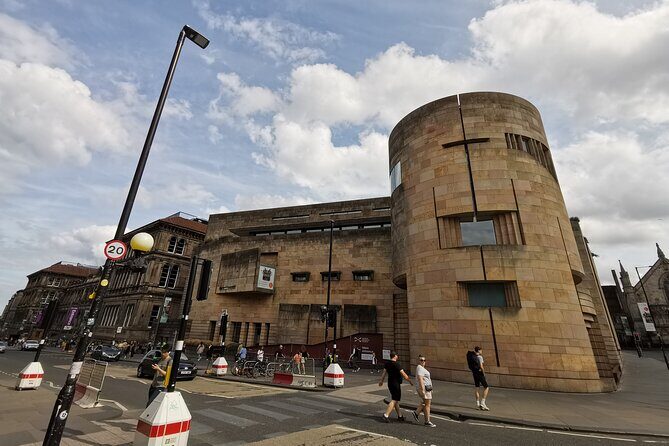
Diagon Alley in the books is described as a cobblestone street with colorful shopfronts. The tour’s approach is simple: as you stroll about Victoria Street, Jule explains the similarities and the secrets behind the matchup. This is where Edinburgh’s Old Town personality does the heavy lifting.
I love this kind of storytelling because it doesn’t depend on indoor access. You can keep walking, you can pause, and you can enjoy the street life at a pace that fits you. It also gives you a good chance to step into shops if you’re in the mood.
Quick heads-up on shops
There’s a real-world risk with any themed shopping stop: storefronts can change. One problem that can pop up is temporary setup during periods of construction. If a particular shop front is closed or relocated on the day you arrive, you can still enjoy the street segment without it derailing your whole tour.
Museum CONTEXT: a focused stop for photos and fan energy

Museum CONTEXT is described as the first Harry Potter shop opened in Edinburgh. For fans, that alone is meaningful. But the real bonus here is the built-in photo opportunity on the third floor.
This stop is short (about 5 minutes), so the tour helps you avoid the trap of spending 45 minutes figuring out what you want before you even start the rest of your walking day. You can use it as a quick photo break and move on.
If you want to linger: treat it like an optional extension. Take the photos you care about, then decide if you want to extend the visit on your own.
Victoria Terrace viewpoints: turn the city into a scene

Victoria Terrace is another quick stop—just enough time to enjoy the view and use your imagination. The tour encourages you to picture the story of Harry Potter happening right in front of you.
I like this kind of pause because it resets your brain. After the dense details of the cemetery and street-level clues, a viewpoint helps you breathe. It also lets you connect the physical city to the feeling of a magical school outside the pages.
Practical tip: if it’s windy or chilly, you’ll appreciate keeping your time here tight and warm-layered. You don’t need to stand still forever for the effect.
New College at the University of Edinburgh and the Hogwarts-style interior vibe

Next is New College, part of the University of Edinburgh. The tour highlights that it has an old library that resembles the Hogwarts library, and a great hall where students eat. It’s the kind of visual cue that Harry Potter fans recognize immediately, especially if you’ve seen the films or read the books closely.
This is marked as not including entrance fees, so if you want to go inside and confirm the look in person, you’ll need to handle any ticketing on your own. Even if you don’t, you’ll likely still get value from the orientation: you understand what to look for and why it’s connected.
My take: if you’re going to spend extra time on one stop, this is a good candidate—because the goal is architecture and atmosphere, not just a quick exterior glance.
The Balmoral Hotel clock tower and the Rowling finish-line moment
Across the valley, the tour points you to the Balmoral Hotel and its clock tower. It also connects the location to a big Rowling milestone: she reportedly finished writing Harry Potter and the Deathly Hallows here. That detail does something interesting. It contrasts the story of triumph with the earlier, simpler writing scenes in cafes around the city.
This stop is a reminder that Edinburgh isn’t just a themed set. It’s a real place tied to the writer’s actual timeline.
If you’re a photo person: this is a great moment to slow down and frame the clock tower with the valley line so you can remember the geography later.
Golden handprints and the Edinburgh Award nod to Rowling
The last segment includes golden handprints on the ground tied to the Edinburgh Award. The tour notes the award has been given since 2007 to a person who has made Edinburgh famous around the world or impacted the city positively, and that in 2008 the award went to JK Rowling.
It’s a quick stop, but it lands. It helps you see why Edinburgh embraces the Harry Potter identity so strongly. This isn’t only fan culture. The city officially recognizes the impact.
Pace, distance, and how long it really takes
The tour is listed as about 2 to 3 hours. In practice, that’s a fair estimate if you’re comfortable moving through each stop quickly and only pausing when the tour tells you to. If you’re the type who stops for photos, snacks, or to check shop windows, plan more time and treat the 2–3 hour estimate as the minimum.
One practical reason the self-guided format works: you don’t have to wait for anyone else. You can go slow at the cemetery. You can speed up on the street segments. That flexibility is the top reason people like this style of tour.
Route order matters more than you think
A key caution: the navigation and the stop logic are designed around following the route sequence. If you try to do it out of order, you may have a harder time finding specific points, especially in the cemetery area where stonework is repetitive. In narrow Old Town streets, GPS can also be less predictable, so staying aligned with the tour’s order helps you avoid wasted time.
What you get in the app (and how it helps you)
This is a private, self-guided experience. That means only your group participates. There’s no live guide included, but you do get an audio guide experience from Jule, plus map support, directions, and a GPS route with stops.
A small but important plus: the audio guide is not described as a computer-generated voice. You also get videos, pictures, and recommendations inside the app, which can help if you’re unsure what you’re looking at while you’re standing there.
You also receive instructions by email to activate your tour in the Pandemic Tours app. The access window is listed as 3 weeks unlimited access, which is handy if you want to revisit later or if you need to start and stop on a busy day.
Price and value: is $12.33 per person a good deal?
At $12.33 per person, you’re paying for a guided narrative plus GPS structure, not for admissions or a live tour guide. That’s what makes the value equation work for the right traveler.
You’ll feel the value most if:
- You like self-paced walks and don’t want to lock into a fixed group schedule.
- You’re traveling on a budget and still want story context at each stop.
- You want to hit a lot of meaningful Harry Potter–connected locations in a short window.
You’ll get less value if:
- You need a lot of hand-holding in navigation.
- You plan to rely on multiple indoor entries because the tour does not include entrance fees for the attractions it mentions.
Should you book this Edinburgh Harry Potter self-guided tour?
If you want a Harry Potter walk that matches real Edinburgh locations with a clear narrative, this is a strong fit. I’d especially recommend it for fans who love the idea of following clues through the city at their own rhythm—coffee breaks, photo stops, and all.
I would not choose it as your only plan if you’re easily frustrated by navigation. The cemetery and Old Town street layout can cost time if you lose the route. Also, if you’re hoping for guaranteed access to every shop window or indoor location, remember that real businesses can change hours, entrances, or setups.
If you’re the kind of traveler who enjoys walking, reading the details where you stand, and using your phone as a guide, you’ll likely enjoy this one.
FAQ
How long is the Edinburgh Harry Potter self-guided tour?
It’s listed as about 2 to 3 hours.
Where does the tour start and end?
It starts at the Greyfriars Bobby Statue in Edinburgh Old Town (EH1 2QE) and ends at Edinburgh City Chambers (253 High St, Edinburgh EH1 1YJ).
What’s included in the price?
You get 3 weeks unlimited access to the tour in the app, plus map, directions, a GPS route with stops, and Jule’s audio guide with audio-related materials like videos and pictures. Entrance fees are not included.
Do I need a live guide?
No. This is a private self-guided experience, so there is no live guide included.
Are attraction entrance fees included?
No. Any entrance fee for the attractions mentioned during the tour is not included.
Does the tour work in English?
Yes, it’s offered in English.
Can I change or get a refund after booking?
No. The experience is non-refundable and cannot be changed for any reason.
]]>I like that you’re not stuck to a rigid schedule. You can start at any hour, take a break, and resume later—so you can fit it around Edinburgh Castle queues, meal plans, or just the weather.
A possible drawback to plan for: the experience depends on the app, and if it’s slow to load or if a clue location feels farther than expected, the game can feel more frustrating than spooky.
Key highlights worth knowing

- Start whenever you want: begin at any hour and resume later without rescheduling
- No internet required: you can play fully offline
- Haunted Edinburgh route, real landmarks: The Mound, Castle Rock sights, St Giles, Mary King’s Close, Greyfriars Bobby, Grassmarket, and more
- Just spooky enough for families: fun at night, with puzzles that can work well with teens
- Private, group-only activity: only your group participates
- Watch for app friction: loading delays and puzzle difficulty can affect your pace
How the Ghosts of Edinburgh game tour actually works

Think of this as a self-guided city walk where the story is delivered through challenges on your phone. You follow the clues to specific places, look around for answers, then move to the next stop. There’s no physical guide leading you by the hand, so you’re in control of how quickly you go.
That freedom matters in Edinburgh. The city rewards wandering, and the route you’ll follow hits big “I can’t believe I’m seeing this” spots—The Mound, major church landmarks, and the Old Town closes—without forcing you to sprint. You’re also allowed to pause. If you need a snack, a bathroom break, or a quick photo detour, you don’t have to feel guilty about slowing down.
This is also a mobile-tickets setup. You’ll use your phone as the ticket and the play device, so bring enough battery to finish comfortably. One downside that shows up in real use: when the app doesn’t load quickly, the whole experience gets less fun.
Price and time: $7.21 for a one-hour haunted walk

At $7.21 per person, the value is strong—especially because you’re getting a structured experience without paying for a separate guide. The tour is listed at about 1 hour, but the real win is that you’re not locked into that exact pacing. If you’re slow (or you stop for photos), you’ll still be playing the same game; you just might stretch your walk a bit.
It’s also good for groups. If you’re traveling with more than 15 people, you can book multiple slots, which keeps things manageable. And there are group discounts available, which can make this a budget-friendly option compared with guided walking tours.
The main price trade-off is that you’re paying for the game structure, not for narration by a person. If what you want most is a living storyteller, you’ll probably miss that. If you want an entertaining reason to walk and look closely, this price feels reasonable.
The Mound: starting on the slope that shaped Princes Street
Your adventure begins at The Mound (Edinburgh EH2 2EL), right where the city’s New Town and Old Town energy start blending. The Mound is an artificial slope, built by dumping earth excavated from the New Town foundations into Nor Loch, which was drained in 1765. That’s a wild little origin story: the ground under your feet is literally made from the city’s construction work.
Here’s how the game starts: you’ll be asked to look around to find an answer that gets you to the next location. In practice, I like starting at The Mound because it’s an easy place to get your bearings. You can also see why this route makes sense: it leads you from open views into denser, more story-heavy parts of the center.
If you’re playing at dusk, The Mound can feel especially atmospheric. Just keep in mind that your phone may be your flashlight—so don’t start if you know your battery is low.
Edinburgh Castle: a fortress with occupation back to the Iron Age
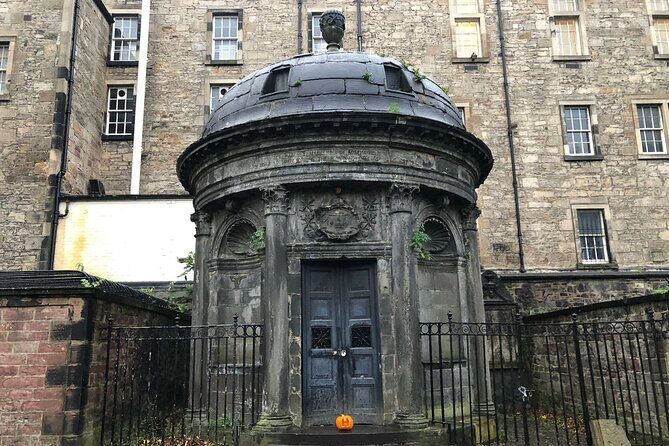
Next up is Edinburgh Castle, sitting on Castle Rock and dominating the skyline. Archaeologists have found evidence of human occupation there since at least the Iron Age, though the earliest settlement details aren’t fully clear. That timeline alone is a reminder that Scotland’s “big moments” here aren’t just medieval pageantry.
In game terms, you’ll again search around to answer a challenge before moving on. This is where careful reading helps, because you’ll need to find the right detail in the real environment—not just guess from what you remember.
One practical note: a negative review complained about needing to pay to enter a ticketed attraction to progress. The provider’s clarification is important: entrance to paid attractions isn’t required to play the games. So if you’re tempted to jump inside a paid area just to satisfy a clue, pause and follow the game instructions first. If you still get stuck, use the help options rather than assuming you must pay.
St Giles’: the church tied to Edinburgh’s patron saint of lepers

From the Castle skyline, you’ll head to St Giles’, with roots dating back to around 1130. A parish church was built for Edinburgh during the reign of King David I, and the church was originally granted to the Lazarites. Its dedication connects to St Giles, patron saint of lepers—and later, patron saint of Edinburgh itself.
For the game, you’ll be looking around for an answer that moves you forward. This stop can feel especially rewarding if you slow down for a moment. You’re not just scanning for a single object—you’re learning how one landmark can carry layers of meaning, from medieval religious administration to a city’s identity.
If you’re playing with kids or teens, this is the kind of stop that can make people talk. Ask each person to point out what they think is the key detail, then check together. If your group includes puzzle-solvers and non-puzzle-solvers, assign roles early so nobody gets stuck.
Mary King’s Close: a “close” you’re meant to explore

Mary King’s Close is in the Royal Mile area of Old Town, under buildings—an enclosed passage (a close) that has its own story world. It’s named for Mary King, a merchant burgess who lived there in the 17th century.
This is one of the most atmospheric areas on your route, and it’s a big reason to do the game at night. Even without dramatic storytelling from a guide, the setting does half the work. The close being “under buildings” also means you’ll be paying attention to details around you rather than just using wide views.
In the game, you’ll be searching for an answer at the stop. That means you shouldn’t treat this as a photo-only stop. Look slowly. If you rush, you’re more likely to miss what the puzzle expects you to notice.
A small sanity tip: if your group splits up to look faster, set a meeting point. Closed lanes and narrow passages can make it easy to lose someone for a few minutes.
Greyfriars Bobby Fountain: the statue that anchors a legend
Then you’ll reach the Greyfriars Bobby Fountain, with a life-size statue of Greyfriars Bobby created by William Brodie in 1872. The statue was funded by Baroness Burdett-Coutts and unveiled on 15 November 1873, standing near the south (main) entrance to Greyfriars Kirkyard.
For the game, you’ll look around to find the answer and continue. This stop is a good example of why a puzzle format can work in a city like Edinburgh. The fountain and statue are well-known landmarks, but the game prompts you to notice specific features instead of strolling past them.
If you want “just spooky enough,” this is a great fit. It’s not jump-scare theatre. It’s a legend-based landmark that still feels grounded and human-scale. That makes it friendly for families and groups of friends—especially when you’re balancing people who love puzzles with those who mainly want atmosphere.
The Grassmarket: cattle fairs, then a public execution site
Next comes the Grassmarket, dating to the 1300s. It was once known for cattle fairs and stables, and later became a trading point for goods. Then, it turns grim: it was also used as a traditional place of public execution.
This is the kind of stop where the game challenge pushes you to slow down and read the space differently. Even if you’re not a “morbid” person, the Grassmarket helps explain why ghost stories stick in specific places. Real locations hold real decisions made in public.
In practical terms, expect this to be one of the stops where the route encourages you to look at surroundings more carefully. If your group is prone to moving too quickly, remind everyone that the puzzle requires observation, not just arrival.
Also, wear comfortable shoes. Even though it’s a one-hour game in theory, the route’s design means you’ll likely make short, repeated movements to check clue details.
New College: a Free Church theological college with strong dates
From the Grassmarket, the game moves you toward New College, founded as the theological college of the Free Church of Scotland. It opened for classes in Edinburgh’s New Town on 1 November 1843, moved to the Mound soon after, and the foundation stone for the current building was laid by Rev Dr Thomas Chalmers on 3 June 1846.
In the game, you’ll again be asked to look around for an answer. I like this stop because it adds a different flavor to the “bloody past” theme. Instead of only focusing on the Old Town’s darker moments, you get a sense of Edinburgh as a place that organized knowledge, training, and belief.
If you’re traveling with history buffs, this is a good moment to point out names and dates—Thomas Chalmers is one you can remember and reuse later in the day. For everyone else, it’s still a solid landmark because it’s tied to a specific institution and time frame, not vague legend.
Scottish National Gallery of Modern Art: finishing near culture, not just ghosts
You’ll also pass by the Scottish National Gallery of Modern Art, first opened in August 1960 at Inverleith House in Edinburgh’s Royal Botanic Garden. It moved to its present site at Modern One on Belford Road in 1984, and then Modern Two opened across the road from Modern One in March 1999.
For the game, this functions as a puzzle stop that shifts the mood. Even if you came for haunted stories, modern art can be a refreshing way to close out the walk. It helps you leave the “ghost” atmosphere without feeling like you’re trapped in it.
Because the tour is game-based and self-guided, you can choose how long you linger. If your group wants to stretch the walk, this is a good place. If you want to finish quickly, you can focus on the game challenge and keep moving.
Old College: where the route ends near University of Edinburgh landmarks
Finally, you’ll reach Old College, a building of the University of Edinburgh on South Bridge. It currently houses parts of the university’s administration, the University of Edinburgh School of Law, and the Talbot Rice Gallery. The building was designed by Robert Adam to replace older buildings.
Your game tour ends at 100 W Bow, Edinburgh EH1 2HH, which is a handy sign of completion. That end point matters because it reduces “what now?” stress. You’re not wandering aimlessly after finishing the puzzles—you’re pointed toward a specific exit from the route.
If you like your evenings planned, this is an advantage. You finish, grab dinner nearby, and move on. If you prefer spontaneity, you can also use Old College and South Bridge as a springboard into more Old Town wandering.
Practical tips for a smoother game (and a better mood)
Here’s what I’d do before you start, based on how this kind of app-driven scavenger hunt tends to behave in real life.
- Charge your phone fully. Loading delays can happen, and you’ll want plenty of battery so you can keep playing without stress.
- Use comfortable walking pace rules. Since each clue expects you to look around, rushing usually costs time.
- Assign roles in groups. One person can read the prompts, another can scan for details, and someone can keep an eye on where the group meets next.
- Don’t assume paid entry is required. The games are designed so you should not need to enter paid attractions to progress. If you’re stuck, follow the game instructions and use help.
- Play when you’re in the right mood. If you want spooky fun, consider night. The experience can feel much more entertaining after dark.
And if your group struggles with tricky wording, treat it like a shared challenge. When you solve together, the whole walk feels like progress—even if a specific clue takes extra time.
Should you book Ghosts of Edinburgh? My take
Book it if you want a self-guided, app-based game that turns famous Edinburgh spots into a puzzle route. The price is low, the start-time flexibility is real, and the offline play makes it easier to enjoy without worrying about data. I also think it’s a strong choice for families and friend groups who like doing something together rather than just watching.
Skip it (or consider alternatives) if you strongly prefer a live guide who explains stories out loud, or if you know you hate dealing with app issues. Since the whole experience relies on your phone, slow loading or hard-to-decipher clues can drain the fun fast. If that’s your style of stress, it might be better to choose a guided ghost tour instead.
FAQ
Do I need an internet connection to play?
No. You can play offline, so you do not need an internet connection to use the game.
How long is the Ghosts of Edinburgh experience?
It’s listed as about 1 hour.
Can I start at any time, or do I need a specific start hour?
You can start at any hour, and you can choose your timing when you begin.
Can I take a break and resume later?
Yes. You have full flexibility to take a break and then resume later.
Where do I start the game tour?
You start at The Mound, Edinburgh EH2 2EL, UK.
Where does the game end?
The experience ends at 100 W Bow, Edinburgh EH1 2HH, UK.
Is the tour offered only in English?
Yes, it’s offered in English.
Is this a private experience or shared with other groups?
It’s private. Only your group participates.
What if our group is larger than 15 people?
If your group is larger than 15, you can make multiple bookings.
Do I need to pay to enter ticketed attractions to complete the game?
No. Entrance to paid attractions is not required to play the games.
Can I get a refund if I cancel?
Yes. There is free cancellation, and you can cancel up to 24 hours in advance for a full refund.
]]>Two things I really value here: first, the tour’s GPS-triggered narration that starts as you approach the next location, so you’re not guessing where the story begins. Second, you get more than just talking points—you also receive directions to both major attractions and smaller sidestreet stops, which makes the walk feel purposeful instead of random.
One drawback to plan around: because it’s self-guided with an app (no in-person guide), you may want extra help if you’re hoping for deeper context on everything—especially the political twists and turnings you might expect from a longer, guided history talk.
Quick hits before you go

- GPS cues that launch the story as you near the next stop, keeping the flow natural
- 40+ narration points across iconic landmarks and quieter corners
- A route that connects major sights from Calton Hill down the Royal Mile toward Greyfriars Kirkyard
- Clear on-the-ground guidance with step-by-step directions to well-known and lesser-seen spots
- You control playback: start, stop, replay, or rewind at any time
- Multi-language audio including English plus German, Spanish, French, Chinese, and Italian
Why an app-led Old Town walk fits Edinburgh so well

Edinburgh’s center rewards you for moving slowly. One minute you’re staring up at a skyline of stone; the next you’re stepping into a street that feels made for foot traffic and quick surprises. This tour leans into that rhythm by letting you roam at your own pace while the audio keeps time for you.
You also avoid a common problem with standard walking tours: when you have a group, someone always wants to pause for photos, someone else wants to speed up, and the guide is stuck managing everyone. Here, the app works for you instead. You choose when to listen, when to look away, and when to backtrack the story by rewinding.
And for $9, the trade-off is pretty reasonable. You’re paying for a 5-hour guided-style walk with 40+ narration points and directions—without paying for entry tickets or an in-person guide. Just remember: you’re not getting a live Q&A, so if you’re the type who asks lots of follow-up questions, you’ll want to be comfortable reading signs or using your own research afterward.
Calton Hill to the Royal Mile: setting your bearings fast
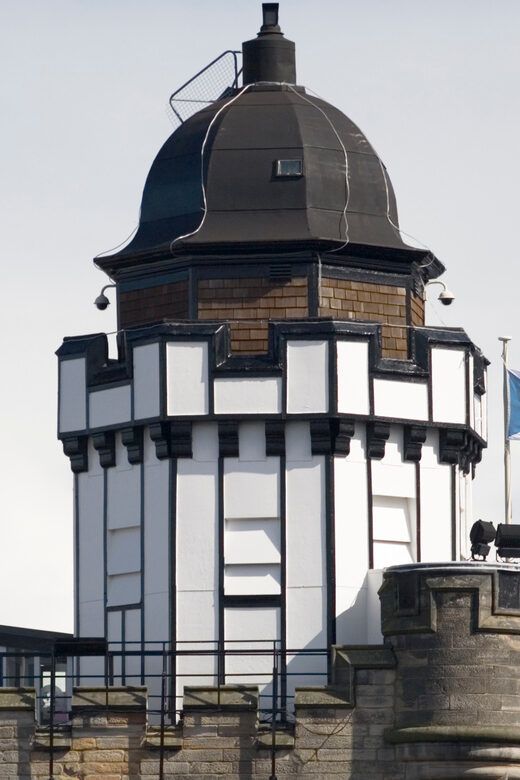
The route begins up on Calton Hill, where you start with big, city-level views. That opening matters. It helps you understand the shape of what you’re about to walk: the Old Town’s steep climbs, stone corridors, and the way major landmarks pull your eye across the skyline.
From there, you head down into the Royal Mile, the historic spine that connects Edinburgh Castle and the Palace of Holyroodhouse, the official residence of the British monarch in Scotland. The tour’s audio ties that connection together as you move. Instead of treating each stop like a standalone postcard, the narration builds a sense of how the city’s power centers and public spaces line up along the ridge.
This section is also a good test of whether the app rhythm will work for you. If you’re the kind of traveler who likes to know what you’re looking at without stopping every two minutes, the GPS-triggered stories should feel smooth. If you prefer long, uninterrupted listening sessions, you may want to plan a few breaks—because you’ll often be walking while the audio speaks.
John Knox House: one landmark, one focused story

After you’ve been oriented by the views and the Royal Mile, you pass John Knox House. The tour’s narration focuses on the intriguing story of one of Scotland’s most notable historical figures—with the house name doing some of the heavy lifting for you.
What I like about a stop like this in an app format is how you can control attention. You can walk on, catch the gist, then pause for a closer look once the story clicks into place. You’re not stuck with a guide’s pace, and you’re not forced to stand still at every landmark.
One note: this part tends to be more story-driven than lecture-driven. A review you might relate to is the one that wished for deeper coverage of political eras and events. So if you’re hoping for a heavy-hitter history class while walking, you’ll likely want a separate plan for that. If you just want a strong narrative thread to carry you from spot to spot, you’ll probably enjoy it.
St Giles’ Cathedral interiors: Gothic architecture you can actually see

Next comes St Giles’ Cathedral, highlighted for its stunning Gothic architecture and wonderful interiors. The tour doesn’t just point and move on. It encourages you to admire what you’re seeing, which is exactly what you want at a place like this.
Here’s how the app format helps: you can stay with the façade and details for as long as you want, then replay the narration if you missed a line. Since you can start, stop, replay, or rewind the audio, you’re not punished for stepping closer to read stonework or checking out interior features.
This stop is also valuable because it shifts the mood. Early on, you’re dealing with viewpoints and civic landmarks. At St Giles’ Cathedral, the story leans into Scotland’s religious history, giving your walk a different emotional temperature.
If you’re sensitive to audio style, pay attention to the narration tone. One feedback point that showed up clearly is that the script can sometimes sound a bit casual, with words that may feel overly modern or teen-like when spoken. That doesn’t ruin the experience, but it’s good to know before you expect a totally formal documentary voice.
Edinburgh Castle from Castle Hill: the fortress as a city symbol

From the Castle Hill area, you get views of Edinburgh Castle, described as an imposing fortress on Castle Rock and an iconic symbol of Edinburgh. The audio here is meant to help you look at the castle not only as a photo-op, but as a defining presence in the Old Town’s story.
Even if you already know the castle is important, this kind of audio guidance still helps because it tells you what to notice while you’re looking at it. Is it the fortress position? The sheer dominance over the ridge? The way it visually anchors the entire walk? The narration points your attention so the view feels less like scenery and more like context.
Also, because you can replay segments, you can use this stop in a practical way. If you arrive during a moment when the view is clear and you catch most of the story, great. If clouds, crowds, or wind interfere, you can catch up by rewinding later.
One more consideration: entry fees aren’t included. So the castle visit here is mainly about views and storytelling rather than stepping inside. If you want time in the museum spaces, you’ll need to plan that separately.
Grassmarket Square: from executions to pubs and people

Then you reach Grassmarket Square, where the audio frames the space with a sharp contrast: it was once the site of public executions, and today it’s known as a lively area with pubs, shops, and cafés.
I like this kind of narration shift because it changes how you stand in the square. You stop treating the area like just another place to grab a drink and start seeing it as a space that has carried heavy stories through time. The app keeps the tone moving so you don’t feel stuck on one mood too long.
This stop can also be a natural pause point for you. Since it’s described as an area with places to eat and drink, it’s a good place to decide whether you want to:
- Keep walking right away to finish the route with the calmer ending, or
- Take a short break and reset your legs before the final stretch.
If you’re hoping for a more detailed chronological account of everything that happened here, you may find the narration is more concise than you want. That matches the overall style feedback: some descriptions are short and to the point, which is great for a self-guided walk, but not ideal if you’re craving a long lecture.
Greyfriars Kirkyard: a quieter ending with a pointed mood

The tour closes at Greyfriars Kirkyard, described as a peaceful yet poignant part of Edinburgh’s history. This ending works well because it gives you a release after the heavier stop at Grassmarket.
You don’t just leave with photos. You leave with tone. The self-guided format helps here because you can slow down without worrying about what a group schedule says. You can listen to the final audio, then linger quietly as long as you like—rewinding if a line feels important.
If you’re the type who likes a reflective finish, this stop is worth pacing carefully. It’s also a good reminder that the app is built to guide you through different emotional beats, not just different buildings.
How long this really takes (and when it feels best)

The tour is set for 5 hours, and that’s a solid half-day. In practice, the time will depend on how often you stop for:
- Photos,
- Looking closely at doors, stone details, and interior spaces,
- And listening all the way through to each narration point.
Because the audio plays automatically as you go along the route, you’ll feel the timing more than you would on a tour where you press play manually. Still, the app gives you control—so if you get delayed, you can replay the story when you catch up.
When it feels best? If you want daylight for views from Calton Hill and Castle Hill, plan for a time when the sky is clear enough to enjoy the skyline. If you’re visiting in cooler or windy weather, pack for it; that walk includes hill sections, and you’ll be on your feet for a long stretch.
What you actually get for $9: value you can feel in your feet

At $9 per person, this is one of the cheaper ways to get a guided-style Old Town walk. The value isn’t just the price—it’s the structure. You receive:
- Access to the Old Town walking tour on the Trippy Tour Guide app
- Over 40 narration points across popular locations
- Detailed directions to well-known attractions plus smaller spots
That matters because Edinburgh can be tricky if you’re trying to connect landmarks yourself. A route like this helps you avoid wandering for long stretches with no sense of what you’re seeing. It also helps you maximize time by keeping you moving through the right areas.
What you don’t get is equally important. There’s no in-person guide, and entry fees aren’t included. So you’re paying for guidance and storytelling, not for ticketed attractions.
If you like independent travel but still want context, this is a good bargain. If you want someone to explain everything in real time and answer your questions, an app won’t replace that.
Practical tips so the audio doesn’t ruin your day
This is the part that makes or breaks app tours. The tour requires you to:
- Bring water
- Use headphones
- Have a charged smartphone
- Make sure the app and tour are downloaded using WiFi
The meeting instructions also stress the need for a strong internet connection for downloading and accessing the tour materials. Translation: arrive ready, not scrambling. If your phone battery is low and your connection is weak, you’ll feel it.
A few small habits help a lot:
- Keep your headphones handy so you don’t miss the first GPS-triggered story
- Pause listening when you cross busy streets, then resume when you’re settled
- If the narration starts before you’re ready, don’t fight it—just rewind when you stop
One more practical point: the app’s stories are designed to play automatically as you go along the route. That’s convenient, but it also means you should stay aware. Don’t get so focused on the audio that you forget where you’re walking.
How the narration style may fit (or not fit) your taste
The tour seems built for easy listening: short segments, clear direction, and lots of stops. That’s a good match for travelers who want a walking pace that stays enjoyable.
Still, there’s one recurring critique you should consider. The narration can sound a little casual, with wording that may feel like it’s aiming for a younger audience. One person also described the language as somewhat dumbed down, almost cringe when read in a voice that sounded older. You might or might not mind this, but it’s worth being aware of if you prefer a more formal, lecture-like tone.
On the flip side, feedback also points out strong execution in some segments: clear diction and a voice that holds attention. And the GPS behavior is praised—GPS that starts narration as you approach the next location makes the whole walk feel stitched together.
So, if you’re flexible with tone and you mainly want a good route with guided-style notes, you’ll likely be happy.
Who this Old Town audio walk is best for
This is a great fit if:
- You like self-paced walking over group herding
- You want a structured route through classic Old Town areas
- You enjoy hearing short stories at each stop rather than long lectures
- You’re okay with learning through audio and signage rather than live Q&A
It’s not the perfect match if:
- You want someone in front of you to explain every question you’ll inevitably have
- You’re hoping for very deep, multi-era political history in every stop
- You dislike narration that sounds casual rather than formal
Should you book this Edinburgh Old Town walking tour?
I’d book it if your goal is a smooth, organized half-day walk where your phone does the storytelling and you spend your energy looking at the city—not tracking directions. The combination of GPS-triggered audio, 40+ narration points, and a route that runs from Calton Hill down the Royal Mile toward Greyfriars Kirkyard is exactly the kind of value you can feel on the ground.
Skip it or pair it with other plans if you need deeper history lessons from a person, or if you’re planning to tour interiors extensively (since entry fees aren’t included and the experience is guided through audio and guidance rather than admissions).
If you do book, go in with the right mindset: press play on curiosity, bring headphones and a charged phone, and let the route guide your eyes through Edinburgh’s Old Town one stop at a time.
FAQ
How long is the Old Town walking tour in Edinburgh?
The tour runs for 5 hours.
How much does it cost?
It’s priced at $9 per person.
What’s included in the tour?
You get access to the Edinburgh: Old Town Walking Tour in the Trippy Tour Guide app, with over 40 narration points and detailed directions to popular locations and smaller spots.
Is there an in-person guide?
No. The tour is provided through the app, and an in-person guide is not included.
Do I need to download anything before starting?
Yes. You must install the app and download the tour using WiFi, then launch the tour on your phone when you arrive.
Does the tour audio play automatically?
Yes. The stories play automatically as you go along the route, and you can start, stop, replay, or rewind as you like.
Which languages are available?
The audio is available in English, German, Spanish, French, Chinese, and Italian.
What if I want to cancel?
Free cancellation is available up to 24 hours in advance for a full refund.
]]>I like the lifetime access model, plus the fact you can download offline audio and maps before you go. I also like that it’s built for independent wandering, so you can pause for a look inside the Writer’s Museum area or step into shops on Victoria Street without feeling rushed.
One thing to consider: the experience is very dependent on your phone and audio delivery while walking. If you struggle with hearing in noisy streets or you don’t stay close to the audio triggers, it can feel finicky.
Key things to know before you go

- Offline-first VoiceMap access means you can keep moving even with spotty signal
- Your pace, your pauses: stop for storefronts and optional museum time
- Starts outside Edinburgh Castle and keeps you out of paid sites
- Greyfriar’s Kirkyard graves are one of the most memorable stops on the route
- Victoria Street shopping stretch adds a fun, fan-friendly wander
- Only English audio so plan your settings if you prefer another language
Value in the real world: what $11.99 buys you

For $11.99 per person, this is less about tickets and more about time and context. You’re paying for a downloadable audio route that helps you connect Edinburgh’s streets to the Harry Potter world, without booking a fixed group tour.
A big value win is the lifetime access. You’re not paying again to replay it later on a different day, in different light, or when you spot something you want to revisit. And because it includes offline audio, maps, and geodata, you’re not stuck hunting for signal at the exact moment you want guidance.
The route is also quick: plan on about 40 minutes to 1 hour at a comfortable walking pace. If you’re in Edinburgh for the first time, that’s a great length. If you want extra time in shops or at the cemetery, you can stretch it—but it’s designed to stay focused.
Before you start: the simple setup that prevents most problems
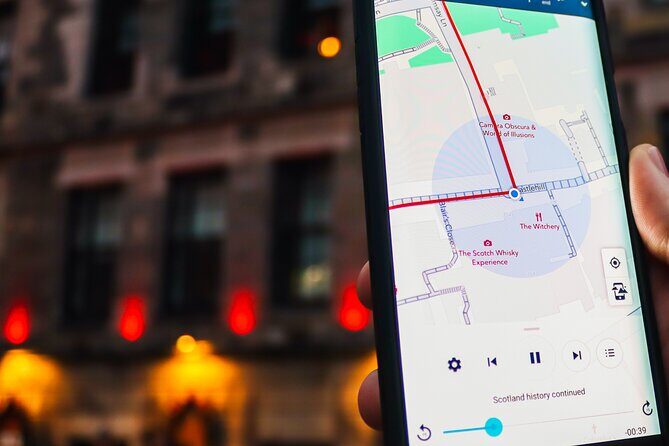
This is a smartphone tour, and the app matters. You use the VoiceMap app on Android or iOS, and you get offline access for audio, maps, and geodata. Since headphones and a smartphone aren’t included, bring your own so you can actually hear the narration over city noise.
Here’s the part that will make or break your experience:
- Download before you leave, so offline audio and maps are ready
- Keep your phone volume up enough for street levels
- When you hear a guide approaching a new spot, stay near the marker rather than walking past and hoping it catches up
Some people find the map/navigation screen less helpful if it doesn’t match how you expect street names to appear. The narration is meant to guide your walk, but if you like seeing road names, be ready to rely more on GPS position and visual cues than on a perfectly labeled map.
Also, the tour is English only. If you set your phone to something else, don’t assume the audio will switch languages for you.
Castlehill kickoff: a filming location outside Edinburgh Castle

The tour starts at Castlehill (EH1). The first big promise here is that you don’t need to enter Edinburgh Castle to get the Harry Potter connection. You’ll be directed to a filming location outside the castle area—more “look and learn” than “stand in line.”
This works well for independent travelers because it keeps the experience low-stress. You get the atmosphere of the castle approach, and the audio helps you notice details you might otherwise skate past.
Practical note: this is a popular sightseeing area. If there are crowds, give yourself extra patience to line up at the right spot for the start prompt.
Writer’s Museum stop: quick peek, optional pause inside

Next, the route stops briefly outside the Writer’s Museum. If you want, you can pause the audio and head inside. The tour timing is flexible, so you’re not locked into a single pace.
This is a smart design choice. It gives you the option to keep moving and stay focused on the full walking route, or to spend a little more time with Edinburgh’s writing culture before continuing to the shop-heavy parts of the walk.
One consideration: because it’s a short stop, decide quickly. If you linger too long outside, you might feel like you’re “behind.” The fix is simple—pause the audio and take your time, then press play again when you’re ready.
Victoria Street walk: shops, story details, and fan momentum

After the Writer’s Museum area, you move through Victoria Street. This is where the Harry Potter mood ramps up. You’ll pass a cluster of Harry Potter–related shops, and the narration keeps you oriented while you browse.
This stop is especially good if you like mixing sightseeing with casual shopping. The tour style lets you pause to step into stores, look at souvenirs, and rejoin when you’re ready—no guide herding anyone down the sidewalk.
If you’re going at a busy time, expect more foot traffic on Victoria Street. That can make audio harder to hear. Keep one ear free if you want to stay aware, or use both earbuds and turn volume a bit higher.
Greyfriar’s Kirkyard: graves that hit harder than you expect

One of the most memorable parts of the route is Greyfriar’s Kirkyard. This is where the audio takes you through the cemetery and points you to graves with familiar names.
Even if you’re not a hardcore Potter completist, this stop tends to land because it mixes two things people often love in Edinburgh: old stone and story clues. It also adds a darker tone than the shop streets, which helps the whole route feel like more than just fan service.
Here’s your practical takeaway: expect uneven ground and slower walking. If you’re short on time, don’t feel you have to rush every audio segment at double speed. Better to slow down, stand still where the audio cues you, and let the cemetery do what it does.
Elephant House ending: the birthplace claim tied to the books

The tour ends at the Elephant House on Victoria Street (21 Victoria St, EH1 1EN). You finish outside, tied to the claim that it’s where JK Rowling wrote the second, third, and fourth Harry Potter books.
This ending is satisfying because it lands the theme of the tour with a real Edinburgh landmark. You’re not only seeing where filming happened; you’re also ending at a place associated with writing. And because you finish outside, you don’t need tickets to complete the route.
One real-world tip: check whether the Elephant House is open when you arrive. The tour is built as an exterior experience, but if the area feels closed or restricted, you may not get the full atmosphere you were expecting.
How to fit it into an Edinburgh day

This is best when you treat it like a flexible “story route” rather than a rigid itinerary. If you’re doing other major sights that day, this audio walk is a quick way to connect them to something fun and specific.
It also works nicely before or after a longer day. Early in the day, you’ll get orientation for the Old Town streets. Later on, you can appreciate the vibe around Victoria Street and finish with a writing-story payoff.
If you’re traveling with kids, this is one of those low-effort activities that can still feel special. The tour’s short segments and pause-friendly format make it easier to keep little legs moving without constant stopping by a schedule.
Who should book this (and who might want something else)
Book it if you:
- Want a self-guided Harry Potter route you can repeat later
- Like walking cities with audio narration instead of group pacing
- Want Harry Potter links but also enjoy the city’s historical tone
- Prefer budget-friendly sightseeing without ticket hassles
You might rethink it if:
- You hate relying on phone audio while navigating crowds
- You need lots of map-based directions, like road names on-screen
- You’re expecting lots of paid-site entry, because the castle is outside-only and museums require separate decisions
Also, think about tone. The narration is described as focused on Harry Potter links, but there can be a very author-forward framing. If you want a more critical, debate-heavy take, you may find it feels a bit one-note.
Should you book Harry Potter’s Edinburgh with VoiceMap?
Yes, if you want a smart, budget-friendly way to get oriented and entertained in a single pass. The combination of offline audio, lifetime access, and a route that avoids entrance-ticket stress makes it good value for independent travel.
No, if you’re the kind of traveler who expects a flawless GPS-like map every step of the way, or if you plan to rely on audio to work in very loud street conditions. In those cases, you may feel like you’re fighting the tech instead of enjoying the walk.
My advice: download it before your trip starts, bring headphones, and treat it like a choose-your-own-pace city story. When it clicks, it’s a fun way to see Edinburgh with Harry Potter glasses on—without losing the city itself.
FAQ
How long is the Harry Potter’s Edinburgh self-guided audio tour?
It’s listed at approximately 40 minutes to 1 hour.
How much does it cost?
The price is $11.99 per person.
Is the tour audio available in English?
Yes. The tour is offered in English.
Can I use the tour offline?
Yes. The included download includes offline access to audio, maps, and geodata.
Do I need to bring a smartphone and headphones?
You do. A smartphone and headphones are not included.
Does the tour include tickets to museums or attractions?
No. Tickets or entrance fees are not included for any stops along the route.
Where does the tour start and end?
It starts outside Edinburgh Castle area at Castlehill, Edinburgh EH1, UK. It ends outside the Elephant House at 21 Victoria St, Edinburgh EH1 1EN, UK.
Does the tour enter Edinburgh Castle?
No. The tour starts outside the castle and does not venture into it.
Can I pause the tour to go into places along the route?
Yes. The Writer’s Museum stop is optional, and you can pause the tour if you choose to go inside.
Is it a private experience?
Yes. It’s private, and only your group participates.
]]>